


Page 422 - Handbook of Materials Failure Analysis
P. 422
420    CHAPTER 16 Degradation of protective PVD coatings


                         tended to exhibit small chipped or spalled regions, while on substrates whose surface
                         is almost free of microcracks, adhesive failure is evidenced as a complete detachment
                         of the coating at relatively high loads, usually initiated at through-thickness cracks
                         (cohesive failure) [62].
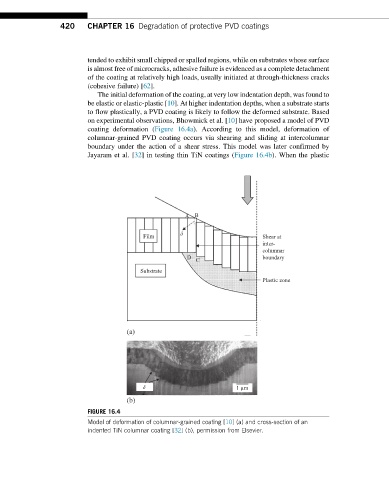
                            The initial deformation of the coating, at very low indentation depth, was found to
                         be elastic or elastic-plastic [10]. At higher indentation depths, when a substrate starts
                         to flow plastically, a PVD coating is likely to follow the deformed substrate. Based
                         on experimental observations, Bhowmick et al. [10] have proposed a model of PVD
                         coating deformation (Figure 16.4a). According to this model, deformation of
                         columnar-grained PVD coating occurs via shearing and sliding at intercolumnar
                         boundary under the action of a shear stress. This model was later confirmed by
                         Jayaram et al. [32] in testing thin TiN coatings (Figure 16.4b). When the plastic


                                                    A B

                                                   δ
                                         Film                             Shear at
                                                                          inter-
                                                                          columnar
                                                     D                    boundary
                                                       C
                                        Substrate
                                                                          Plastic zone


                                    (a)


                                         δ                        1 μm

                                    (b)
                         FIGURE 16.4
                         Model of deformation of columnar-grained coating [10] (a) and cross-section of an
                         indented TiN columnar coating [32] (b), permission from Elsevier.

