


Page 418 - Handbook of Materials Failure Analysis
P. 418
416    CHAPTER 16 Degradation of protective PVD coatings


                         TiC x N 1 x coating. With increasing carbon in coating (higher x), intrinsic stresses
                         began to increase at lower bias voltage.
                            Investigations of an effect of bias voltage on coating hardness showed that the
                         decrease of bias voltage first caused an increase of coating hardness, but later with
                         further increase of bias voltage the coating hardness decreased regardless of the
                         deposition method, for example, in coatings deposited by arc evaporation [8], unbal-
                         anced magnetron sputtering technique [25,41], and ion plating [29]. However, the
                         rate of decrease of the hardness was dependent on the deposition method.
                            An increase of bias voltage magnitude (from 0 to  300 V) caused an increase of
                         coating adhesion in CrN x coatings prepared by reactive magnetron sputtering [21],
                         while in arc-evaporated films (CrN) caused a decrease of coating adhesion [17,44].
                            Summarizing, bias voltage affects many coating properties and is one of the most
                         important parameters of coating deposition.
                            Temperature of a substrate, similar to bias voltage, is a very important deposition
                         parameter. According to Thornton’s model, substrate temperature has an influence
                         on coating morphology. However, many investigations [24,26,29,39,45] showed that
                         substrate temperature has also an influence on a coating grain size and hardness.
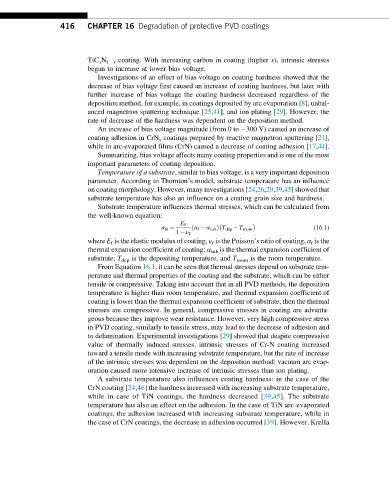
                            Substrate temperature influences thermal stresses, which can be calculated from
                         the well-known equation:
                                                   E f
                                              σ th ¼  ð α f  α sub Þ T dep  T room      (16.1)
                                                  1 ν f
                         where E f is the elastic modulus of coating, ν f is the Poisson’s ratio of coating, α f is the
                         thermal expansion coefficient of coating; α sub is the thermal expansion coefficient of
                         substrate; T dep is the depositing temperature, and T room is the room temperature.
                            From Equation 16.1, it can be seen that thermal stresses depend on substrate tem-
                         perature and thermal properties of the coating and the substrate, which can be either
                         tensile or compressive. Taking into account that in all PVD methods, the deposition
                         temperature is higher than room temperature, and thermal expansion coefficient of
                         coating is lower than the thermal expansion coefficient of substrate, then the thermal
                         stresses are compressive. In general, compressive stresses in coating are advanta-
                         geous because they improve wear resistance. However, very high compressive stress
                         in PVD coating, similarly to tensile stress, may lead to the decrease of adhesion and
                         to delamination. Experimental investigations [29] showed that despite compressive
                         value of thermally induced stresses, intrinsic stresses of Cr-N coating increased
                         toward a tensile mode with increasing substrate temperature, but the rate of increase
                         of the intrinsic stresses was dependent on the deposition method: vacuum arc evap-
                         oration caused more intensive increase of intrinsic stresses than ion plating.
                            A substrate temperature also influences coating hardness: in the case of the
                         CrN coating [24,46] the hardness increased with increasing substrate temperature,
                         while in case of TiN coatings, the hardness decreased [39,45]. The substrate
                         temperature has also an effect on the adhesion. In the case of TiN arc-evaporated
                         coatings, the adhesion increased with increasing substrate temperature, while in
                         the case of CrN coatings, the decrease in adhesion occurred [39]. However, Krella

