


Page 414 - Handbook of Materials Failure Analysis
P. 414
412    CHAPTER 16 Degradation of protective PVD coatings


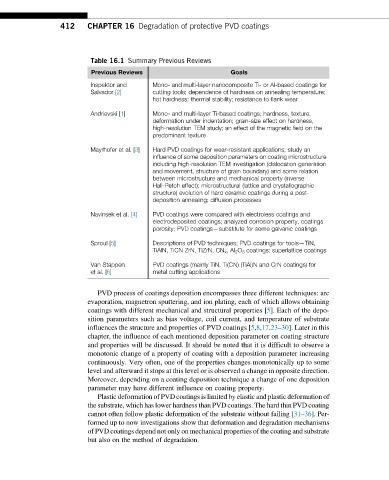
                          Table 16.1 Summary Previous Reviews
                          Previous Reviews                       Goals
                          Inspektor and    Mono- and multi-layer nanocomposite Ti- or Al-based coatings for
                          Salvador [2]     cutting tools; dependence of hardness on annealing temperature;
                                           hot hardness; thermal stability; resistance to flank wear
                          Andrievski [1]   Mono- and multi-layer Ti-based coatings; hardness, texture,
                                           deformation under indentation; grain-size effect on hardness,
                                           high-resolution TEM study; an effect of the magnetic field on the
                                           predominant texture

                          Mayrhofer et al. [3]  Hard PVD coatings for wear-resistant applications; study an
                                           influence of some deposition parameters on coating microstructure
                                           including high-resolution TEM investigation (dislocation generation
                                           and movement, structure of grain boundary) and some relation
                                           between microstructure and mechanical property (inverse
                                           Hall-Petch effect); microstructural (lattice and crystallographic
                                           structure) evolution of hard ceramic coatings during a post-
                                           deposition annealing; diffusion processes

                          Navinsek et al. [4]  PVD coatings were compared with electroless coatings and
                                           electrodeposited coatings; analyzed corrosion property, coatings
                                           porosity; PVD coatings—substitute for some galvanic coatings

                          Sproul [5]       Descriptions of PVD techniques; PVD coatings for tools—TiN,
                                           TiAlN, TiCN ZrN, TiZrN, CN x ,Al 2 O 3 coatings; superlattice coatings
                          Van Stappen      PVD coatings (mainly TiN, Ti(CN) (TiAl)N and CrN coatings) for
                          et al. [6]       metal cutting applications

                            PVD process of coatings deposition encompasses three different techniques: arc
                         evaporation, magnetron sputtering, and ion plating, each of which allows obtaining
                         coatings with different mechanical and structural properties [5]. Each of the depo-
                         sition parameters such as bias voltage, coil current, and temperature of substrate
                         influences the structure and properties of PVD coatings [5,8,17,23–30]. Later in this
                         chapter, the influence of each mentioned deposition parameter on coating structure
                         and properties will be discussed. It should be noted that it is difficult to observe a
                         monotonic change of a property of coating with a deposition parameter increasing
                         continuously. Very often, one of the properties changes monotonically up to some
                         level and afterward it stops at this level or is observed a change in opposite direction.
                         Moreover, depending on a coating deposition technique a change of one deposition
                         parameter may have different influence on coating property.
                            Plastic deformation of PVD coatings is limited by elastic and plastic deformation of
                         the substrate, which has lower hardness than PVD coatings. The hard thin PVD coating
                         cannot often follow plastic deformation of the substrate without failing [31–36]. Per-
                         formed up to now investigations show that deformation and degradation mechanisms
                         of PVD coatings depend not only on mechanical properties of the coating and substrate
                         but also on the method of degradation.

