


Page 416 - Handbook of Materials Failure Analysis
P. 416
414    CHAPTER 16 Degradation of protective PVD coatings


                                                                   Columnar grains
                                             Transition structure
                                            consisting of densely
                                            packed fibrous grains
                              Porous structure
                             consisting of tapered                              Recrystallized
                                                                               grain structure
                            crystallites separated
                                by voids
                                                                           ZONE 3
                                                                ZONE 2


                                                                                       1.0
                                                ZONE 1                              0.9
                                                           ZONE T
                                                                                 0.8
                                                                              0.7
                                  30
                                                                           0.6
                                                                        0.5  Substrate
                                         20
                                                                     0.4
                                                                            temperature (T/T M )
                                        Argon                     0.3
                                       pressure  10            0.2
                                       (m torr)             0.1
                                                       1
                                               Influence of substrate temperature
                                               and argon pressure on microstructure
                                               of sputtered films
                         FIGURE 16.2
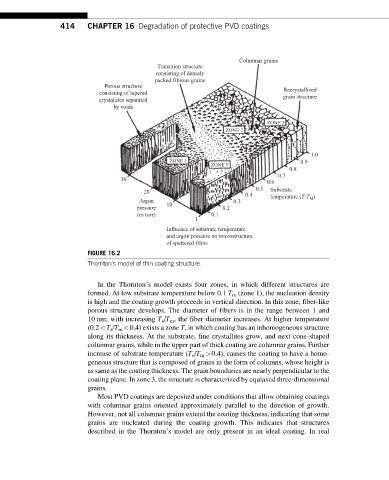
                         Thornton’s model of thin coating structure.

                            In the Thornton’s model exists four zones, in which different structures are
                         formed. At low substrate temperature below 0.1 T m (zone 1), the nucleation density
                         is high and the coating growth proceeds in vertical direction. In this zone, fiber-like
                         porous structure develops. The diameter of fibers is in the range between 1 and
                         10 nm; with increasing T s /T m , the fiber diameter increases. At higher temperature
                         (0.2<T s /T m <0.4) exists a zone T, in which coating has an inhomogeneous structure
                         along its thickness. At the substrate, fine crystallites grow, and next cone-shaped
                         columnar grains, while in the upper part of thick coating are columnar grains. Further
                         increase of substrate temperature (T s /T m >0.4), causes the coating to have a homo-
                         geneous structure that is composed of grains in the form of columns, whose height is
                         as same as the coating thickness. The grain boundaries are nearly perpendicular to the
                         coating plane. In zone 3, the structure is characterized by equiaxed three-dimensional
                         grains.
                            Most PVD coatings are deposited under conditions that allow obtaining coatings
                         with columnar grains oriented approximately parallel to the direction of growth.
                         However, not all columnar grains extend the coating thickness, indicating that some
                         grains are nucleated during the coating growth. This indicates that structures
                         described in the Thornton’s model are only present in an ideal coating. In real

