


Page 420 - Handbook of Materials Failure Analysis
P. 420
418    CHAPTER 16 Degradation of protective PVD coatings


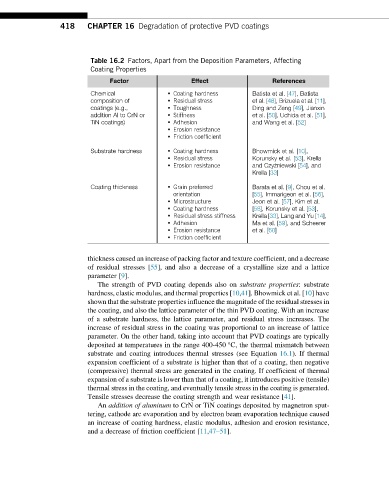
                          Table 16.2 Factors, Apart from the Deposition Parameters, Affecting
                          Coating Properties
                               Factor                 Effect                 References
                          Chemical              • Coating hardness     Batista et al. [47], Batista
                          composition of        • Residual stress      et al. [48], Brizuela et al. [11],
                          coatings (e.g.,       • Toughness            Ding and Zeng [49], Jianxin
                          addition Al to CrN or  • Stiffness           et al. [50], Uchida et al. [51],
                          TiN coatings)         • Adhesion             and Wang et al. [52]
                                                • Erosion resistance
                                                • Friction coefficient

                          Substrate hardness    • Coating hardness     Bhowmick et al. [10],
                                                • Residual stress      Korunsky et al. [53], Krella
                                                • Erosion resistance   and Czyz ˙niewski [54], and
                                                                       Krella [33]
                          Coating thickness     • Grain preferred      Barata et al. [9], Chou et al.
                                                 orientation           [55], Immarigeon et al. [56],
                                                • Microstructure       Jeon et al. [57], Kim et al.
                                                • Coating hardness     [58], Korunsky et al. [53],
                                                • Residual stress stiffness  Krella [33], Lang and Yu [14],
                                                • Adhesion             Ma et al. [59], and Scheerer
                                                • Erosion resistance   et al. [60]
                                                • Friction coefficient

                         thickness caused an increase of packing factor and texture coefficient, and a decrease
                         of residual stresses [55], and also a decrease of a crystalline size and a lattice
                         parameter [9].
                            The strength of PVD coating depends also on substrate properties: substrate
                         hardness, elastic modulus, and thermal properties [10,41]. Bhowmick et al. [10] have
                         shown that the substrate properties influence the magnitude of the residual stresses in
                         the coating, and also the lattice parameter of the thin PVD coating. With an increase
                         of a substrate hardness, the lattice parameter, and residual stress increases. The
                         increase of residual stress in the coating was proportional to an increase of lattice
                         parameter. On the other hand, taking into account that PVD coatings are typically
                         deposited at temperatures in the range 400-450 °C, the thermal mismatch between
                         substrate and coating introduces thermal stresses (see Equation 16.1). If thermal
                         expansion coefficient of a substrate is higher than that of a coating, then negative
                         (compressive) thermal stress are generated in the coating. If coefficient of thermal
                         expansion of a substrate is lower than that of a coating, it introduces positive (tensile)
                         thermal stress in the coating, and eventually tensile stress in the coating is generated.
                         Tensile stresses decrease the coating strength and wear resistance [41].
                            An addition of aluminum to CrN or TiN coatings deposited by magnetron sput-
                         tering, cathode arc evaporation and by electron beam evaporation technique caused
                         an increase of coating hardness, elastic modulus, adhesion and erosion resistance,
                         and a decrease of friction coefficient [11,47–51].

