


Page 424 - Handbook of Materials Failure Analysis
P. 424
422    CHAPTER 16 Degradation of protective PVD coatings


                                                   Structure of layer materials  Structure in interface  Number of layers


                                                                          Thickness of each layer
                              Hardness of each layer
                                                                            (modulation period)


                                      Properties of multilayer coatings:
                                              hardness
                                              toughness
                                              plasticity
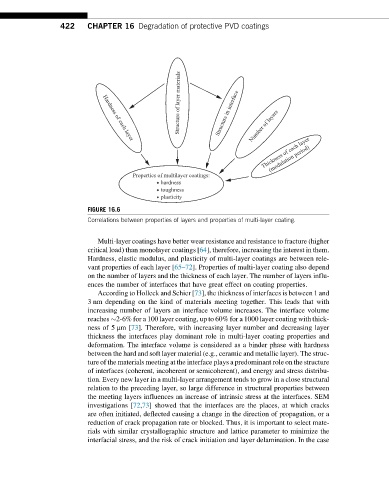
                         FIGURE 16.6
                         Correlations between properties of layers and properties of multi-layer coating.

                            Multi-layer coatings have better wear resistance and resistance to fracture (higher
                         critical load) than monolayer coatings [64], therefore, increasing the interest in them.
                         Hardness, elastic modulus, and plasticity of multi-layer coatings are between rele-
                         vant properties of each layer [65–72]. Properties of multi-layer coating also depend
                         on the number of layers and the thickness of each layer. The number of layers influ-
                         ences the number of interfaces that have great effect on coating properties.
                            According to Holleck and Schier [73], the thickness of interfaces is between 1 and
                         3 nm depending on the kind of materials meeting together. This leads that with
                         increasing number of layers an interface volume increases. The interface volume
                         reaches  2-6% for a 100 layer coating, up to 60% for a 1000 layer coating with thick-
                         ness of 5 μm[73]. Therefore, with increasing layer number and decreasing layer
                         thickness the interfaces play dominant role in multi-layer coating properties and
                         deformation. The interface volume is considered as a binder phase with hardness
                         between the hard and soft layer material (e.g., ceramic and metallic layer). The struc-
                         ture of the materials meeting at the interface plays a predominant role on the structure
                         of interfaces (coherent, incoherent or semicoherent), and energy and stress distribu-
                         tion. Every new layer in a multi-layer arrangement tends to grow in a close structural
                         relation to the preceding layer, so large difference in structural properties between
                         the meeting layers influences an increase of intrinsic stress at the interfaces. SEM
                         investigations [72,73] showed that the interfaces are the places, at which cracks
                         are often initiated, deflected causing a change in the direction of propagation, or a
                         reduction of crack propagation rate or blocked. Thus, it is important to select mate-
                         rials with similar crystallographic structure and lattice parameter to minimize the
                         interfacial stress, and the risk of crack initiation and layer delamination. In the case

