


Page 427 - Handbook of Materials Failure Analysis
P. 427
5 Deformation of Multi-Layer Coatings  425


                     In metal-ceramic multi-layer coatings, cracks are initiated at interfaces and
                  developed in hard and brittle ceramic layers and block at next interface
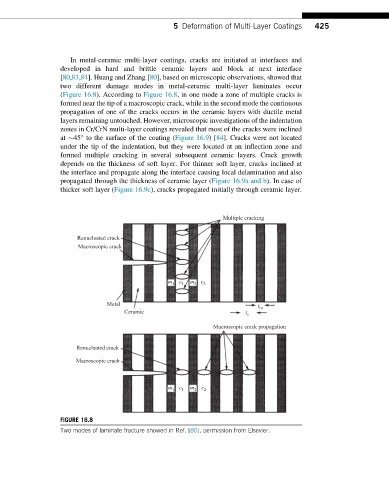
                  [80,83,84]. Huang and Zhang [80], based on microscopic observations, showed that
                  two different damage modes in metal-ceramic multi-layer laminates occur
                  (Figure 16.8). According to Figure 16.8, in one mode a zone of multiple cracks is
                  formed near the tip of a macroscopic crack, while in the second mode the continuous
                  propagation of one of the cracks occurs in the ceramic layers with ductile metal
                  layers remaining untouched. However, microscopic investigations of the indentation
                  zones in Cr/CrN multi-layer coatings revealed that most of the cracks were inclined
                  at  45° to the surface of the coating (Figure 16.9)[84]. Cracks were not located
                  under the tip of the indentation, but they were located at an inflection zone and
                  formed multiple cracking in several subsequent ceramic layers. Crack growth
                  depends on the thickness of soft layer. For thinner soft layer, cracks inclined at
                  the interface and propagate along the interface causing local delamination and also
                  propagated through the thickness of ceramic layer (Figure 16.9a and b). In case of
                  thicker soft layer (Figure 16.9c), cracks propagated initially through ceramic layer.


                                                               Multiple cracking


                      Renucleated crack
                       Macroscopic crack


                                                m 1 c 1  m 2 c 2


                               Metal                                    t m
                                   Ceramic                           t c
                                                            Macroscopic crack propagation


                      Renucleated crack
                      Macroscopic crack


                                                m 1  c 1  m 2  c 2


                  FIGURE 16.8
                  Two modes of laminate fracture showed in Ref. [80], permission from Elsevier.

