


Page 426 - Handbook of Materials Failure Analysis
P. 426
424    CHAPTER 16 Degradation of protective PVD coatings


                                  45
                                                                      Cheng et al. [67]
                                  40                                  Duck et al. [68]
                                                                      Krella [77]
                                  35
                                                                      Zhao et al. [74]
                                  30
                                Hardness (GPa)  25


                                  20

                                  15

                                  10
                                  5

                                  0
                                    0   200  400  600  800  1000  1200  1400  1600  1800  2000
                                                    Modulation period (nm)
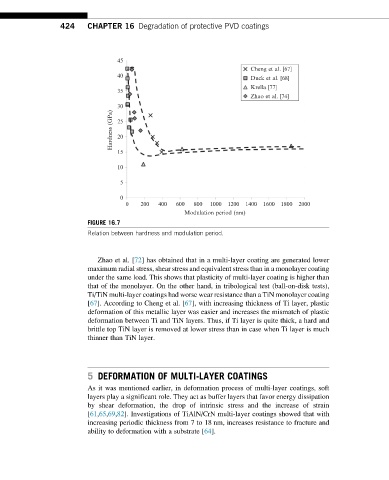
                         FIGURE 16.7
                         Relation between hardness and modulation period.


                            Zhao et al. [72] has obtained that in a multi-layer coating are generated lower
                         maximum radial stress, shear stress and equivalent stress than in a monolayer coating
                         under the same load. This shows that plasticity of multi-layer coating is higher than
                         that of the monolayer. On the other hand, in tribological test (ball-on-disk tests),
                         Ti/TiN multi-layer coatings had worse wear resistance than a TiN monolayer coating
                         [67]. According to Cheng et al. [67], with increasing thickness of Ti layer, plastic
                         deformation of this metallic layer was easier and increases the mismatch of plastic
                         deformation between Ti and TiN layers. Thus, if Ti layer is quite thick, a hard and
                         brittle top TiN layer is removed at lower stress than in case when Ti layer is much
                         thinner than TiN layer.


                         5 DEFORMATION OF MULTI-LAYER COATINGS

                         As it was mentioned earlier, in deformation process of multi-layer coatings, soft
                         layers play a significant role. They act as buffer layers that favor energy dissipation
                         by shear deformation, the drop of intrinsic stress and the increase of strain
                         [61,65,69,82]. Investigations of TiAlN/CrN multi-layer coatings showed that with
                         increasing periodic thickness from 7 to 18 nm, increases resistance to fracture and
                         ability to deformation with a substrate [64].

