


Page 431 - Handbook of Materials Failure Analysis
P. 431
6 Fatigue Strength of PVD Coating   429


                          20
                                 TiN (Kim et al. [58])
                          18     TiAIN (Kim et al. [58])
                                 TiCN (Kim et al. [58])
                          16
                         Increase of fatigue endurance (%)  12 8
                                 CrN (Baragetti et al. [100])
                          14

                          10


                           4 6

                           2
                           0
                             0     500   1000   1500   2000   2500   3000   3500
                                              Coating hardness (HV)
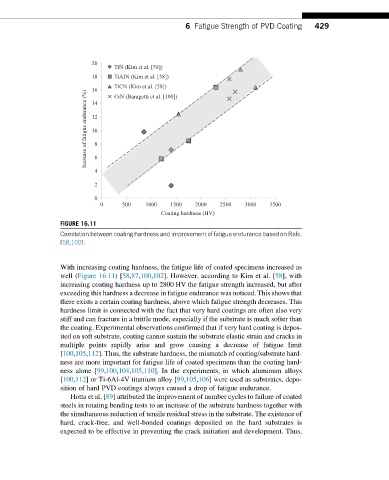
                  FIGURE 16.11
                  Correlation between coating hardness and improvement of fatigue endurance based on Refs.
                  [58,100].


                  With increasing coating hardness, the fatigue life of coated specimens increased as
                  well (Figure 16.11)[58,87,100,102]. However, according to Kim et al. [58], with
                  increasing coating hardness up to 2800 HV the fatigue strength increased, but after
                  exceeding this hardness a decrease in fatigue endurance was noticed. This shows that
                  there exists a certain coating hardness, above which fatigue strength decreases. This
                  hardness limit is connected with the fact that very hard coatings are often also very
                  stiff and can fracture in a brittle mode, especially if the substrate is much softer than
                  the coating. Experimental observations confirmed that if very hard coating is depos-
                  ited on soft substrate, coating cannot sustain the substrate elastic strain and cracks in
                  multiple points rapidly arise and grow causing a decrease of fatigue limit
                  [100,105,112]. Thus, the substrate hardness, the mismatch of coating/substrate hard-
                  ness are more important for fatigue life of coated specimens than the coating hard-
                  ness alone [99,100,104,105,110]. In the experiments, in which aluminum alloys
                  [100,112] or Ti-6Al-4V titanium alloy [99,105,106] were used as substrates, depo-
                  sition of hard PVD coatings always caused a drop of fatigue endurance.
                     Hotta et al. [89] attributed the improvement of number cycles to failure of coated
                  steels in rotating bending tests to an increase of the substrate hardness together with
                  the simultaneous reduction of tensile residual stress in the substrate. The existence of
                  hard, crack-free, and well-bonded coatings deposited on the hard substrates is
                  expected to be effective in preventing the crack initiation and development. Thus,

