


Page 425 - Handbook of Materials Failure Analysis
P. 425
4 Properties of Multi-Layer Coatings  423


                  of ceramic multi-layer coatings, with increasing number of layers, the hardness of the
                  whole coating increases [73,74].
                     During deformation, soft layers act as buffer layers that reduce an interfacial
                  stress and increase strain [65]. A Ti/TiN multi-layer coating with increasing thick-
                  ness of soft Ti layers toward the substrate possess the better wear resistance than
                  coatings with decreasing or stable thickness of Ti layers [65]. Bromark et al. [75]
                  and Kim et al. [69] have noticed that with increasing the amount of Ti in Ti/TiN
                  multi-layer coating, hardness of the whole coating decreases. A relative amount
                  of metallic element (e.g., Ti) in a coating has been proposed as a coating parameter
                  that correlates with the hardness of the whole multi-layer coating or with residual
                  stresses in the coating. Similar results (the decrease of hardness with increasing rel-
                  ative amount of metallic element in a coating) were obtained in Cheng et al. [67] and
                  Wiecinski et al. [70]. For example, in case of Ti/TiN multi-layer coatings, when the
                  thickness of metallic Ti layer increased from 0 to 150 nm with an unchanged thick-
                  ness of the ceramic layer of 240 nm, so the relative amount of metallic element in
                  coatings increased, the hardness decreased from 32 to 16 GPa [67]. Similar effect
                  was obtained in Cr/CrN multi-layer coatings [70]. Based on mentioned correlation
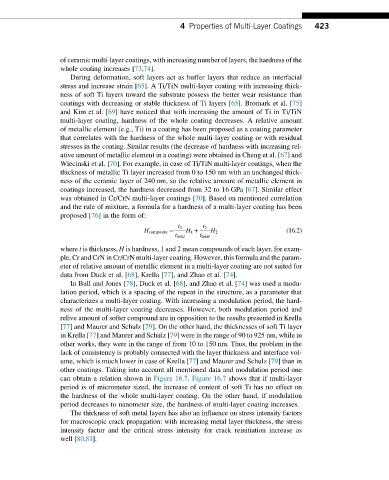
                  and the rule of mixture, a formula for a hardness of a multi-layer coating has been
                  proposed [76] in the form of:
                                                  t 1    t 2
                                         H composite ¼  H 1 +  H 2              (16.2)
                                                  t total  t total
                  where t is thickness, H is hardness, 1 and 2 mean compounds of each layer, for exam-
                  ple, Cr and CrN in Cr/CrN multi-layer coating. However, this formula and the param-
                  eter of relative amount of metallic element in a multi-layer coating are not suited for
                  data from Duck et al. [68], Krella [77], and Zhao et al. [74].
                     In Bull and Jones [78], Duck et al. [68], and Zhao et al. [74] was used a modu-
                  lation period, which is a spacing of the repeat in the structure, as a parameter that
                  characterizes a multi-layer coating. With increasing a modulation period, the hard-
                  ness of the multi-layer coating decreases. However, both modulation period and
                  relive amount of softer compound are in opposition to the results presented in Krella
                  [77] and Maurer and Schulz [79]. On the other hand, the thicknesses of soft Ti layer
                  in Krella [77] and Maurer and Schulz [79] were in the range of 90 to 925 nm, while in
                  other works, they were in the range of from 10 to 150 nm. Thus, the problem in the
                  lack of consistency is probably connected with the layer thickness and interface vol-
                  ume, which is much lower in case of Krella [77] and Maurer and Schulz [79] than in
                  other coatings. Taking into account all mentioned data and modulation period one
                  can obtain a relation shown in Figure 16.7. Figure 16.7 shows that if multi-layer
                  period is of micrometer sized, the increase of content of soft Ti has no effect on
                  the hardness of the whole multi-layer coating. On the other hand, if modulation
                  period decreases to nanometer size, the hardness of multi-layer coating increases.
                     The thickness of soft metal layers has also an influence on stress intensity factors
                  for macroscopic crack propagation: with increasing metal layer thickness, the stress
                  intensity factor and the critical stress intensity for crack reinitiation increase as
                  well [80,81].

