


Page 421 - Handbook of Materials Failure Analysis
P. 421
3 Deformation of Monolayer Coatings   419


                     Properties of coatings with addition of Al, similarly to coating without Al, depend
                  on deposition parameters. In case of CrAlN coatings, their properties depend on
                  Al/Cr ratio: with an increase of Al/Cr ratio up to 0.4-0.5, hardness and elastic mod-
                  ulus increased, but further increase of Al/Cr ratio caused a decrease of these prop-
                  erties [49]. A decrease of bias voltage magnitude from  50 to  260 V caused an
                  increase of coating density, with lowered coating defects, increased coating hard-
                  ness, elastic modulus, and toughness, and decreased the grain size in chromium alu-
                  minum nitride coatings deposited via magnetron sputtering [31]. However,
                  investigations shown in Wang et al. [52] revealed the decrease of hardness, elastic
                  modulus, and critical load in scratch test, as a result of addition of aluminum to CrN
                  coating deposited by electron beam evaporation technique.


                  3 DEFORMATION OF MONOLAYER COATINGS

                  The deformation mechanism of PVD coatings is influenced by the structural morphol-
                  ogy of the coating and the hardness of substrate, and is preceded by the elasto-plastic
                  deformation of the substrate [10,61]. High-resolution TEM study of TiN coating
                  revealed the presence of edge dislocations inside columnar crystallites [1,3]. The dis-
                  locations confirmed possibility of plastic deformations in hard brittle TiN coating. Nev-
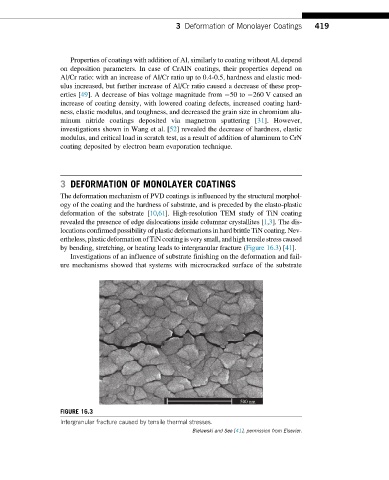
                  ertheless,plastic deformationofTiN coatingis verysmall,andhightensilestress caused
                  by bending, stretching, or heating leads to intergranular fracture (Figure 16.3)[41].
                     Investigations of an influence of substrate finishing on the deformation and fail-
                  ure mechanisms showed that systems with microcracked surface of the substrate


                                                                    500 nm
                  FIGURE 16.3
                  Intergranular fracture caused by tensile thermal stresses.
                                                      Bielawski and Seo [41], permission from Elsevier.

