


Page 453 - Handbook of Materials Failure Analysis
P. 453
3 Results    451


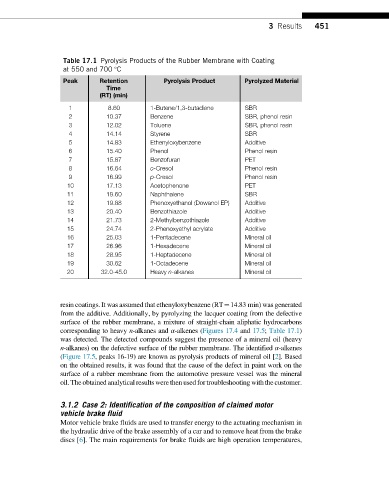
                   Table 17.1 Pyrolysis Products of the Rubber Membrane with Coating
                   at 550 and 700 °C
                   Peak      Retention        Pyrolysis Product      Pyrolyzed Material
                               Time
                             (RT) (min)
                    1          8.60        1-Butene/1,3-butadiene    SBR
                    2          10.37       Benzene                   SBR, phenol resin
                    3          12.02       Toluene                   SBR, phenol resin
                    4          14.14       Styrene                   SBR
                    5          14.83       Ethenyloxybenzene         Additive
                    6          15.40       Phenol                    Phenol resin
                    7          15.87       Benzofuran                PET
                    8          16.64       o-Cresol                  Phenol resin
                    9          16.99       p-Cresol                  Phenol resin
                    10         17.13       Acetophenone              PET
                    11         19.60       Naphthalene               SBR
                    12         19.88       Phenoxyethanol (Dowanol EP)  Additive
                    13         20.40       Benzothiazole             Additive
                    14         21.73       2-Methylbenzothiazole     Additive
                    15         24.74       2-Phenoxyethyl acrylate   Additive
                    16         25.03       1-Pentadecene             Mineral oil
                    17         26.96       1-Hexadecene              Mineral oil
                    18         28.95       1-Heptadecene             Mineral oil
                    19         30.62       1-Octadecene              Mineral oil
                    20       32.0-45.0     Heavy n-alkanes           Mineral oil


                  resin coatings. It was assumed that ethenyloxybenzene (RT¼14.83 min) was generated
                  from the additive. Additionally, by pyrolyzing the lacquer coating from the defective
                  surface of the rubber membrane, a mixture of straight-chain aliphatic hydrocarbons
                  corresponding to heavy n-alkanes and α-alkenes (Figures 17.4 and 17.5; Table 17.1)
                  was detected. The detected compounds suggest the presence of a mineral oil (heavy
                  n-alkanes) on the defective surface of the rubber membrane. The identified α-alkenes
                  (Figure 17.5, peaks 16-19) are known as pyrolysis products of mineral oil [2]. Based
                  on the obtained results, it was found that the cause of the defect in paint work on the
                  surface of a rubber membrane from the automotive pressure vessel was the mineral
                  oil.The obtained analytical results were then used for troubleshooting withthe customer.


                  3.1.2 Case 2: Identification of the composition of claimed motor
                  vehicle brake fluid
                  Motor vehicle brake fluids are used to transfer energy to the actuating mechanism in
                  the hydraulic drive of the brake assembly of a car and to remove heat from the brake
                  discs [6]. The main requirements for brake fluids are high operation temperatures,

