


Page 463 - Handbook of Materials Failure Analysis
P. 463
3 Results    461


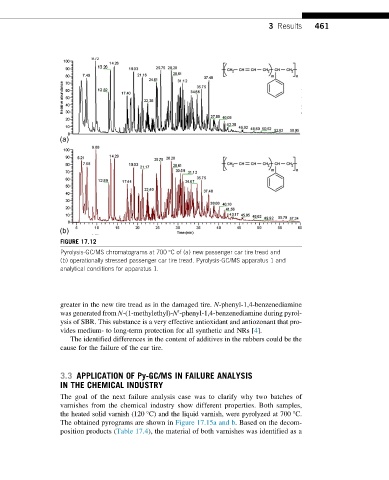
                  FIGURE 17.12
                  Pyrolysis-GC/MS chromatograms at 700 °C of (a) new passenger car tire tread and
                  (b) operationally stressed passenger car tire tread. Pyrolysis-GC/MS apparatus 1 and
                  analytical conditions for apparatus 1.


                  greater in the new tire tread as in the damaged tire. N-phenyl-1,4-benzenediamine
                                                  0
                  was generated from N-(1-methylethyl)-N -phenyl-1,4-benzenediamine during pyrol-
                  ysis of SBR. This substance is a very effective antioxidant and antiozonant that pro-
                  vides medium- to long-term protection for all synthetic and NRs [4].
                     The identified differences in the content of additives in the rubbers could be the
                  cause for the failure of the car tire.


                  3.3 APPLICATION OF Py-GC/MS IN FAILURE ANALYSIS
                  IN THE CHEMICAL INDUSTRY
                  The goal of the next failure analysis case was to clarify why two batches of
                  varnishes from the chemical industry show different properties. Both samples,
                  the heated solid varnish (120 °C) and the liquid varnish, were pyrolyzed at 700 °C.
                  The obtained pyrograms are shown in Figure 17.15a and b. Based on the decom-
                  position products (Table 17.4), the material of both varnishes was identified as a

