


Page 462 - Handbook of Materials Failure Analysis
P. 462
460    CHAPTER 17 Application of pyrolysis


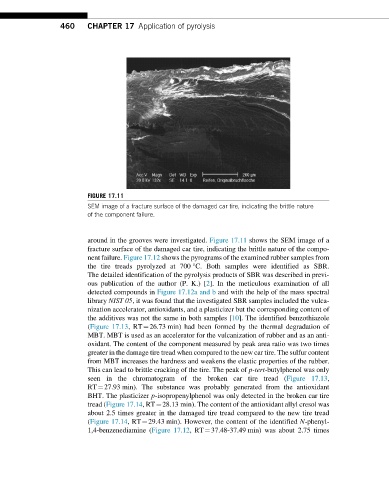
                         FIGURE 17.11
                         SEM image of a fracture surface of the damaged car tire, indicating the brittle nature
                         of the component failure.


                         around in the grooves were investigated. Figure 17.11 shows the SEM image of a
                         fracture surface of the damaged car tire, indicating the brittle nature of the compo-
                         nent failure. Figure 17.12 shows the pyrograms of the examined rubber samples from
                         the tire treads pyrolyzed at 700 °C. Both samples were identified as SBR.
                         The detailed identification of the pyrolysis products of SBR was described in previ-
                         ous publication of the author (P. K.) [2]. In the meticulous examination of all
                         detected compounds in Figure 17.12a and b and with the help of the mass spectral
                         library NIST 05, it was found that the investigated SBR samples included the vulca-
                         nization accelerator, antioxidants, and a plasticizer but the corresponding content of
                         the additives was not the same in both samples [10]. The identified benzothiazole
                         (Figure 17.13,RT¼26.73 min) had been formed by the thermal degradation of
                         MBT. MBT is used as an accelerator for the vulcanization of rubber and as an anti-
                         oxidant. The content of the component measured by peak area ratio was two times
                         greater in the damage tire tread when compared to the new car tire. The sulfur content
                         from MBT increases the hardness and weakens the elastic properties of the rubber.
                         This can lead to brittle cracking of the tire. The peak of p-tert-butylphenol was only
                         seen in the chromatogram of the broken car tire tread (Figure 17.13,
                         RT¼27.93 min). The substance was probably generated from the antioxidant
                         BHT. The plasticizer p-isopropenylphenol was only detected in the broken car tire
                         tread (Figure 17.14,RT¼28.13 min). The content of the antioxidant allyl cresol was
                         about 2.5 times greater in the damaged tire tread compared to the new tire tread
                         (Figure 17.14,RT¼29.43 min). However, the content of the identified N-phenyl-
                         1,4-benzenediamine (Figure 17.12,RT¼37.48-37.49 min) was about 2.75 times

