


Page 341 - Handbook of Thermodynamic Diagrams 1 : Organic Compounds C1 to C4
P. 341
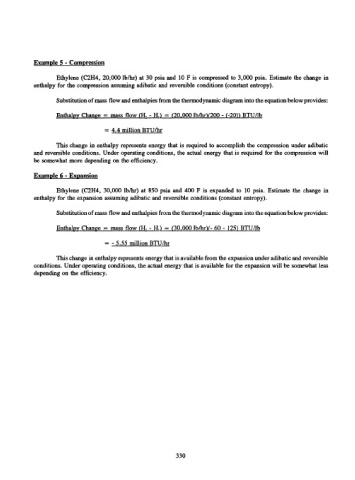
Example 5 - Compression

              Ethylene (C2H4, 20,000 Ib/hr) at 30 psia and 10 F is compressed to 3,000 psia. Estimate the change in
       enthalpy for the compression assuming adibatic and reversible conditions (constant entropy).

              Substitution of mass flow and enthalpies from the thermodynamic diagram into the equation below provides:

              Enthalpy Change = mass flow (H, - H,^ = (20.000 lb/hrV200 - (-20)) BTU/lb
                             = 4.4 million BTU/hr


              This change in enthalpy represents energy that is required to accomplish the compression under adibatic
       and reversible conditions. Under operating conditions, the actual energy that is required for the compression will
      be somewhat more depending on the efficiency.


      Example 6 - Expansion
              Ethylene (C2H4, 30,000 Ib/hr) at 850 psia and 400 F is expanded to 10 psia. Estimate the change in
       enthalpy for the expansion assuming adibatic and reversible conditions (constant entropy).

              Substitution of mass flow and enthalpies from the thermodynamic diagram into the equation below provides:

              Enthalpy Change = mass flow (H 2 - H 1) = (30.000 Ib/hrK- 60 - 125) BTU/lb

                             = -5.55 million BTU/hr

              This change in enthalpy represents energy that is available from the expansion under adibatic and reversible
       conditions. Under operating conditions, the actual energy that is available for the expansion will be somewhat less
       depending on the efficiency.


                                                    330

