


Page 505 - High Power Laser Handbook
P. 505
472   Fi b er   L a s er s                              Pulsed Fiber Lasers    473


                      Here A is beam area and P is peak power. Even in the most extreme
                      single-mode Yb-doped fibers (e.g., A = ~5000 μm ), corresponding to
                                                               2
                      the LP  mode in a ~100-μm core fiber, and for P exceeding P  by a
                            01
                                                                           c
                      mere 10 percent, L  is already less than 15 mm—that is, it is much
                                      c
                      shorter than any fiber length of practical usability. In bulk crystals,
                      however, A can be much larger, and significant energy can be extracted
                      even in a few centimeter lengths.
                         So far, the high-peak-power onset of SF in rare-earth-doped, as
                      well as transport, fibers has proved a rather elusive phenomenon to
                      conclusively observe. There still exists experimental evidence with
                      which the theory has not been completely reconciled. One of them
                      pertains to the SF behavior of high-order fiber modes, which are cal-
                      culated to exhibit intrinsic P  values that are several times higher than
                                             c
                      LP ,  but  which  are  then  predicted  to  undergo  spatial  instabilities
                        01
                      during propagation and to incur collapse at about the same power
                      level of 4 to 5 MW.  Further analysis is warranted, as such a descrip-
                                      15
                      tion does not seem consistent with the reported delivery of greater
                      than 20 MW peak power pulses with a highly multimode passive
                          18
                      fiber.  Moreover, alternative analyses have recently been presented
                      according to which the in-fiber P  for LP  does depend on mode field
                                                 c
                                                       01
                      area, due to the onset of spatial beam filamentation, which is caused
                      by spatial hole burning in fiber amplifiers. 19
                         Fiber facets are normally subject to damage at much lower irradi-
                      ance values than the fiber bulk. However, this difference is largely
                      extrinsic and ascribed to the fiber facet’s much lower optical quality,
                      which is due to imperfections left behind by the cleaving and polish-
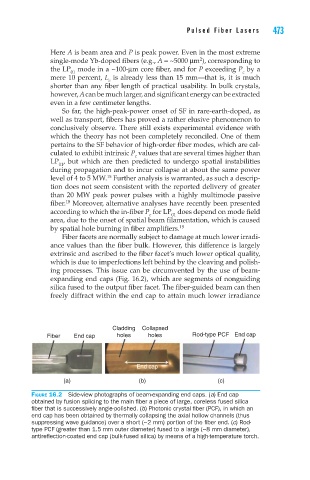
                      ing processes. This issue can be circumvented by the use of beam-
                      expanding end caps (Fig. 16.2), which are segments of nonguiding
                      silica fused to the output fiber facet. The fiber-guided beam can then
                      freely diffract within the end cap to attain much lower irradiance


                                       Cladding  Collapsed
                     Fiber  End cap     holes    holes       Rod-type PCF  End cap


                                              End cap
                          (a)                 (b)                   (c)

                 Figure 16.2  Side-view photographs of beam-expanding end caps. (a) End cap
                 obtained by fusion splicing to the main fiber a piece of large, coreless fused silica
                 fiber that is successively angle-polished. (b) Photonic crystal fiber (PCF), in which an
                 end cap has been obtained by thermally collapsing the axial hollow channels (thus
                 suppressing wave guidance) over a short (~2 mm) portion of the fiber end. (c) Rod-
                 type PCF (greater than 1.5 mm outer diameter) fused to a large (~8 mm diameter),
                 antireflection-coated end cap (bulk-fused silica) by means of a high-temperature torch.

