


Page 501 - High Power Laser Handbook
P. 501
468   Fi b er   L a s er s                              Pulsed Fiber Lasers    469


                      signature is the appearance and ensuing power buildup of two side
                      bands of equal frequency spacing with respect to the pump beam.
                      Because of the induced power transfer from the main (pump) beam
                      to such satellite spectral sidebands (often many nanometers away),
                      FWM represents a major limitation when it occurs in PFLs and pulsed
                      fiber amplifiers meant to retain high spectral brightness. The effec-
                      tiveness of this power transfer can be further enhanced by SRS, when
                      FWM side bands occur where significant Raman gain is available, as
                      well as by nonlinear phase modulation. In fact, such nonlinearities
                      can cascade in a runaway fashion if the peak in-core irradiance is
                      increased indefinitely, which results in the cumulative effect of super-
                      continuum generation.
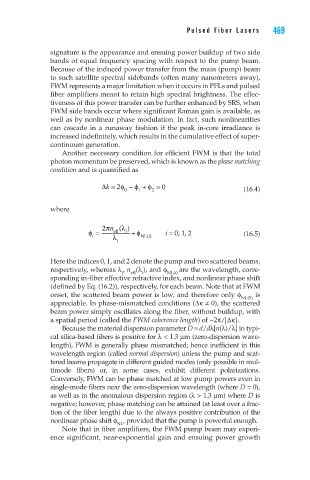
                         Another necessary condition for efficient FWM is that the total
                      photon momentum be preserved, which is known as the phase matching
                      condition and is quantified as

                                     k
                                    ∆= 2 φ  -  + φ  φ  = 0                 (16.4)
                                          0   1   2
                      where

                                    2 π   λn ()
                                φ =    eff  i  +  φ   i = 01 2             (16.5)
                                                         ,,
                                 i     λ       NL() i
                                        i
                      Here the indices 0, 1, and 2 denote the pump and two scattered beams,
                      respectively, whereas λ , n (λ ), and φ NL(i)  are the wavelength, corre-
                                          i
                                               i
                                            eff
                      sponding in-fiber effective refractive index, and nonlinear phase shift
                      (defined by Eq. (16.2)), respectively, for each beam. Note that at FWM
                      onset, the scattered beam power is low, and therefore only φ NL(0)  is
                      appreciable. In phase-mismatched conditions (∆k ≠ 0), the scattered
                      beam power simply oscillates along the fiber, without buildup, with
                      a spatial period (called the FWM coherence length) of ~2π/|∆k|.
                         Because the material dispersion parameter D = d/dλ[n(λ)/λ] in typi-
                      cal silica-based fibers is positive for λ < 1.3 μm (zero-dispersion wave-
                      length), FWM is generally phase mismatched; hence inefficient in this
                      wavelength region (called normal dispersion) unless the pump and scat-
                      tered beams propagate in different guided modes (only possible in mul-
                      timode  fibers)  or,  in  some  cases,  exhibit  different  polarizations.
                      Conversely, FWM can be phase matched at low pump powers even in
                      single-mode fibers near the zero-dispersion wavelength (where D = 0),
                      as well as in the anomalous dispersion region (λ > 1.3 μm) where D is
                      negative; however, phase matching can be attained (at least over a frac-
                      tion of the fiber length) due to the always positive contribution of the
                      nonlinear phase shift φ , provided that the pump is powerful enough.
                                        NL
                         Note that in fiber amplifiers, the FWM pump beam may experi-
                      ence significant, near-exponential gain and ensuing power growth

