


Page 497 - High Power Laser Handbook
P. 497
464   Fi b er   L a s er s                              Pulsed Fiber Lasers    465


                      optical confinement in the small guiding core of typical long fibers.
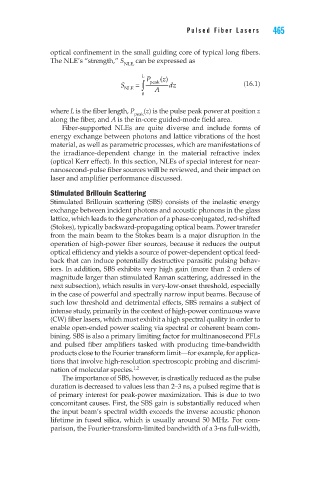
                      The NLE’s “strength,” S NLE,  can be expressed as

                                               L  P  z ()
                                             =
                                         S NLE ∫  peak  dz                 (16.1)
                                               0   A

                      where L is the fiber length, P peak (z) is the pulse peak power at position z
                      along the fiber, and A is the in-core guided-mode field area.
                         Fiber-supported  NLEs  are  quite  diverse  and  include  forms  of
                      energy exchange between photons and lattice vibrations of the host
                      material, as well as parametric processes, which are manifestations of
                      the  irradiance-dependent  change  in  the  material  refractive  index
                      (optical Kerr effect). In this section, NLEs of special interest for near-
                      nanosecond-pulse fiber sources will be reviewed, and their impact on
                      laser and amplifier performance discussed.

                      Stimulated Brillouin Scattering
                      Stimulated Brillouin scattering (SBS) consists of the inelastic energy
                      exchange between incident photons and acoustic phonons in the glass
                      lattice, which leads to the generation of a phase-conjugated, red-shifted
                      (Stokes), typically backward-propagating optical beam. Power transfer
                      from the main beam to the Stokes beam is a major disruption in the
                      operation of high-power fiber sources, because it reduces the output
                      optical efficiency and yields a source of power-dependent optical feed-
                      back that can induce potentially destructive parasitic pulsing behav-
                      iors. In addition, SBS exhibits very high gain (more than 2 orders of
                      magnitude larger than stimulated Raman scattering, addressed in the
                      next subsection), which results in very-low-onset threshold, especially
                      in the case of powerful and spectrally narrow input beams. Because of
                      such low threshold and detrimental effects, SBS remains a subject of
                      intense study, primarily in the context of high-power continuous wave
                      (CW) fiber lasers, which must exhibit a high spectral quality in order to
                      enable open-ended power scaling via spectral or coherent beam com-
                      bining. SBS is also a primary limiting factor for multinanosecond PFLs
                      and  pulsed  fiber  amplifiers  tasked  with  producing  time-bandwidth
                      products close to the Fourier transform limit—for example, for applica-
                      tions that involve high-resolution spectroscopic probing and discrimi-
                                             1,2
                      nation of molecular species.
                         The importance of SBS, however, is drastically reduced as the pulse
                      duration is decreased to values less than 2–3 ns, a pulsed regime that is
                      of primary interest for peak-power maximization. This is due to two
                      concomitant causes. First, the SBS gain is substantially reduced when
                      the input beam’s spectral width exceeds the inverse acoustic phonon
                      lifetime in fused silica, which is usually around 50 MHz. For com-
                      parison, the Fourier-transform-limited bandwidth of a 3-ns full-width,

