


Page 502 - High Power Laser Handbook
P. 502
470    Fi b er   L a s er s                                                                                                       Pulsed Fiber Lasers     471


                      over  short  distances,  comparable  to  the  FWM  coherence  length
                      defined earlier. This occurrence breaks down the oscillatory nature of
                      the power exchange between the pump and scattered beams and may
                      lead to substantial FWM buildup even in non-phase-matched condi-
                      tions in the normal dispersion wavelength region (~1 μm). 10,11
                         Similar to the behavior of SBS and nonlinear phase modulation dis-
                      cussed earlier, the impact of FWM also becomes enhanced when a frac-
                      tion  of  the  main  beam  power  is  distributed  over  secondary,  closely
                      spaced spectral components, such as multiple longitudinal modes. In
                      such cases, FWM side bands can become effectively “seeded” at these
                      satellite frequencies (rather than building up from diminutive parametric
                      noise) and, thus, set in at much lower peak powers, especially if the ini-
                      tial spectral features are separated by few tens of gigahertz or less.
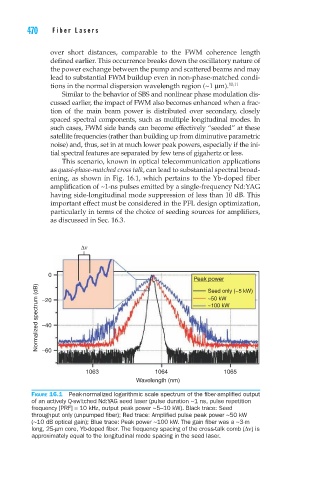
                         This scenario, known in optical telecommunication applications
                      as quasi-phase-matched cross talk, can lead to substantial spectral broad-
                      ening, as shown in Fig. 16.1, which pertains to the Yb-doped fiber
                      amplification of ~1-ns pulses emitted by a single-frequency Nd:YAG
                      having side-longitudinal mode suppression of less than 10 dB. This
                      important effect must be considered in the PFL design optimization,
                      particularly in terms of the choice of seeding sources for amplifiers,
                      as discussed in Sec. 16.3.


                              ∆ν


                     0
                                                             Peak power
                  Normalized spectrum (dB)  −20                  ~50 kW
                                                                 Seed only (~5 kW)
                                                                 ~100 kW


                    −40


                    −60


                                1063               1064               1065
                                              Wavelength (nm)
                 Figure 16.1  Peak-normalized logarithmic scale spectrum of the fiber-amplified output
                 of an actively Q-switched Nd:YAG seed laser (pulse duration ~1 ns, pulse repetition
                 frequency [PRF] = 10 kHz, output peak power ~5–10 kW). Black trace: Seed
                 throughput only (unpumped fiber); Red trace: Amplified pulse peak power ~50 kW
                 (~10 dB optical gain); Blue trace: Peak power ~100 kW. The gain fiber was a ~3-m
                 long, 25-μm core, Yb-doped fiber. The frequency spacing of the cross-talk comb (∆ν) is
                 approximately equal to the longitudinal mode spacing in the seed laser.

