


Page 503 - High Power Laser Handbook
P. 503
470   Fi b er   L a s er s                              Pulsed Fiber Lasers    471


                      16.2.2  Amplified Spontaneous Emission
                      A fraction of the spontaneous emission (isotropically distributed over
                      the entire solid angle) from excited-state rare earth ions in the fiber is
                      captured in the core and becomes bidirectionally guided through it
                      and amplified via stimulated emission when in the presence of exist-
                      ing population inversion. In the interval between pulses, when only
                      the pump beam is present in the fiber and the population inversion is
                      being built up (i.e., when energy is being stored in the core), such ASE
                      will continue to grow in power to the extent that, beyond a certain
                      point, any further absorbed amount of pump power is simply ren-
                      dered into ASE and does not lead to any additional increase in the
                      excited-state  population.  As  a  general  rule,  this  begins  to  happen
                      when the stimulated and spontaneous emission rates become compa-
                      rable. By limiting the population inversion, the ASE limits the achiev-
                      able small-signal gain G and ultimately the energy extractable by the
                      incoming pulse, which is given by
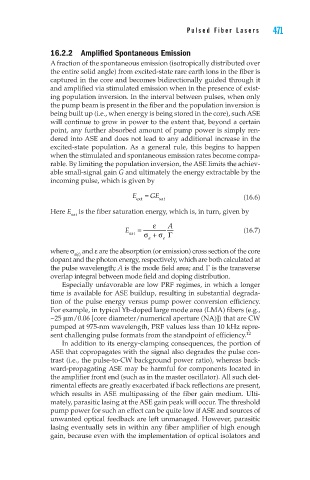
                                             E  =  GE sat                   (16.6)
                                              ext
                      Here E  is the fiber saturation energy, which is, in turn, given by
                            sat
                                                  ε   A
                                           E sat  =                        (16.7)
                                                σ  a  + σ  e  Γ
                      where σ  and ε are the absorption (or emission) cross section of the core
                             a(e)
                      dopant and the photon energy, respectively, which are both calculated at
                      the pulse wavelength; A is the mode field area; and Γ is the transverse
                      overlap integral between mode field and doping distribution.
                         Especially unfavorable are low PRF regimes, in which a longer
                      time is available for ASE buildup, resulting in substantial degrada-
                      tion of the pulse energy versus pump power conversion efficiency.
                      For example, in typical Yb-doped large mode area (LMA) fibers (e.g.,
                      ~25 μm/0.06 [core diameter/numerical aperture (NA)]) that are CW
                      pumped at 975-nm wavelength, PRF values less than 10 kHz repre-
                      sent challenging pulse formats from the standpoint of efficiency. 12
                         In addition to its energy-clamping consequences, the portion of
                      ASE that copropagates with the signal also degrades the pulse con-
                      trast (i.e., the pulse-to-CW background power ratio), whereas back-
                      ward-propagating ASE may be harmful for components located in
                      the amplifier front end (such as in the master oscillator). All such det-
                      rimental effects are greatly exacerbated if back reflections are present,
                      which results in ASE multipassing of the fiber gain medium. Ulti-
                      mately, parasitic lasing at the ASE gain peak will occur. The threshold
                      pump power for such an effect can be quite low if ASE and sources of
                      unwanted optical feedback are left unmanaged. However, parasitic
                      lasing eventually sets in within any fiber amplifier of high enough
                      gain, because even with the implementation of optical isolators and

