


Page 499 - High Power Laser Handbook
P. 499
466   Fi b er   L a s er s                              Pulsed Fiber Lasers    467


                      significant SRS suppression can occur only when the Stokes pulse
                      (which exhibits lower group velocity) accumulates a delay compara-
                      ble to the pulse duration over a sufficiently short portion of the fiber.
                      Such a walk-off effect becomes important in fused-silica fibers only for
                      pulse widths less than 10 ps and is nearly negligible for nanosecond
                      pulses. Moreover, the SRS gain bandwidth is much larger (~40 THz)
                      than SBS; therefore, the effect strength remains virtually unchanged,
                      even for very broad pulse spectra.
                         In light of the above characteristics, SRS is a dominant NLE for
                      the near-nanosecond regime, and its mitigation appears possible only
                      through a direct reduction of the S NLE  value or by means of specialty
                      fiber designs, in which high propagation loss is selectively introduced
                      for the SRS-generated field. Recently proposed SRS-suppressing solu-
                                                             4
                      tions in the latter category include dual-hole,  W-shaped-core,  and
                                                                           5
                      photonic stop-band fibers. 6
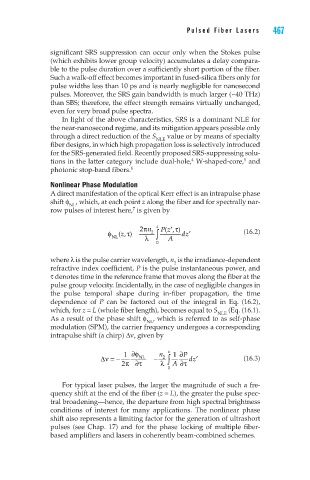
                      Nonlinear Phase Modulation
                      A direct manifestation of the optical Kerr effect is an intrapulse phase
                      shift φ , which, at each point z along the fiber and for spectrally nar-
                           NL
                      row pulses of interest here,  is given by
                                             7
                                               2 πn  z  Pz′  τ)
                                                     (,
                                           τ
                                      φ  NL (, )  λ  2  ∫  A  dz′          (16.2)
                                         z
                                                   0
                      where λ is the pulse carrier wavelength, n  is the irradiance-dependent
                                                        2
                      refractive index coefficient, P is the pulse instantaneous power, and
                      τ denotes time in the reference frame that moves along the fiber at the
                      pulse group velocity. Incidentally, in the case of negligible changes in
                      the  pulse  temporal  shape  during  in-fiber  propagation,  the  time
                      dependence  of  P  can  be  factored  out  of  the  integral  in  Eq.  (16.2),
                      which, for z = L (whole fiber length), becomes equal to S NLE  (Eq. (16.1).
                      As a result of the phase shift φ , which is referred to as self-phase
                                                NL
                      modulation (SPM), the carrier frequency undergoes a corresponding
                      intrapulse shift (a chirp) ∆ν, given by

                                          1  ∂φ     n  z  1  ∂P
                                     ν
                                    ∆= -   π  NL  -  λ  2  ∫  ∂τ  dz ′     (16.3)
                                             ∂τ 2     0  A
                         For typical laser pulses, the larger the magnitude of such a fre-
                      quency shift at the end of the fiber (z = L), the greater the pulse spec-
                      tral broadening—hence, the departure from high spectral brightness
                      conditions  of  interest  for  many  applications.  The  nonlinear  phase
                      shift also represents a limiting factor for the generation of ultrashort
                      pulses  (see  Chap.  17)  and  for  the  phase  locking  of  multiple  fiber-
                      based amplifiers and lasers in coherently beam-combined schemes.

