Page 130 - Hydrogeology Principles and Practice
P. 130
HYDC03  12/5/05  5:37 PM  Page 113


                                                                               Chemical hydrogeology  113


                                                                                               BO X
                     Microbially mediated denitrification
                                                                                               3.9

                     The sequences of redox reactions shown in Tables 3.11 and 3.12  elements required in large amounts (C, H, O, N, P, S), minor amounts
                     are thermodynamically favoured, but their reaction rates are slow   of minerals (K, Na, Mg, Ca, Fe) and trace amounts of certain metals
                     in the absence of catalysts. In natural waters, the most important  (Mn, Zn, Cu, Co and Mo). On the basis of average cellular composi-
                     electron-transfer mechanism is catalysis associated with micro-  tion, the favourable ratio of C : N : P : S is about 100 : 20 : 4 : 1
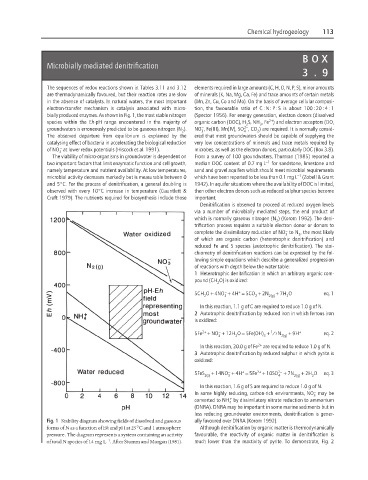
                     bially produced enzymes. As shown in Fig. 1, the most stable nitrogen  (Spector 1956). For energy generation, electron donors (dissolved
                                                                                     2+
                     species within the Eh-pH range encountered in the majority of  organic carbon (DOC), H S, NH , Fe ) and electron acceptors (DO,
                                                                               2
                                                                                   3
                                                                  −
                                                                              2−
                     groundwaters is erroneously predicted to be gaseous nitrogen (N ).  NO , Fe(III), Mn(IV), SO , CO ) are required. It is normally consid-
                                                            2
                                                                  3
                                                                                  2
                                                                              4
                     The observed departure from equilibrium is explained by the  ered that most groundwaters should be capable of supplying the
                     catalysing effect of bacteria in accelerating the biological reduction  very low concentrations of minerals and trace metals required by
                        −
                     of NO at lower redox potentials (Hiscock et al. 1991).  microbes, as well as the electron donors, particularly DOC (Box 3.8).
                        3
                      The viability of micro-organisms in groundwater is dependent on  From a survey of 100 groundwaters, Thurman (1985) reported a
                     two important factors that limit enzymatic function and cell growth,  median DOC content of 0.7 mg L −1  for sandstone, limestone and
                     namely temperature and nutrient availability. At low temperatures,  sand and gravel aquifers which should meet microbial requirements
                                                                                             −1
                     microbial activity decreases markedly but is measurable between 0  which have been reported to be less than 0.1 mg L (Zobell & Grant
                     and 5°C. For the process of denitrification, a general doubling is  1942). In aquifer situations where the availability of DOC is limited,
                     observed with every 10°C increase in temperature (Gauntlett &  then other electron donors such as reduced sulphur species become
                     Craft 1979). The nutrients required for biosynthesis include those  important.
                                                                 Denitrification is observed to proceed at reduced oxygen levels
                                                                via a number of microbially mediated steps, the end product of
                                                                which is normally gaseous nitrogen (N ) (Korom 1992). The deni-
                                                                                       2
                                                                trification process requires a suitable electron donor or donors to
                                                                                          −
                                                                complete the dissimilatory reduction of NO to N , the most likely
                                                                                          3
                                                                                              2
                                                                of which are organic carbon (heterotrophic denitrification) and
                                                                reduced Fe and S species (autotrophic denitrification). The stoi-
                                                                chiometry of denitrification reactions can be expressed by the fol-
                                                                lowing simple equations which describe a generalized progression
                                                                of reactions with depth below the water table:
                                                                1 Heterotrophic denitrification in which an arbitrary organic com-
                                                                pound (CH O) is oxidized:
                                                                      2
                                                                            +
                                                                        −
                                                                5CH O + 4NO + 4H = 5CO + 2N 2(g) + 7H O  eq. 1
                                                                  2
                                                                        3
                                                                                 2
                                                                                          2
                                                                 In this reaction, 1.1 g of C are required to reduce 1.0 g of N.
                                                                2 Autotrophic denitrification by reduced iron in which ferrous iron
                                                                is oxidized:
                                                                  2+
                                                                       −
                                                                                      1
                                                                5Fe + NO + 12H O = 5Fe(OH) + /2N 2(g) + 9H +  eq. 2
                                                                       3
                                                                           2
                                                                                    3
                                                                                  2+
                                                                 In this reaction, 20.0 g of Fe are required to reduce 1.0 g of N.
                                                                3 Autotrophic denitrification by reduced sulphur in which pyrite is
                                                                oxidized:
                                                                                  2+
                                                                             +
                                                                         −
                                                                5FeS 2(s) + 14NO + 4H = 5Fe + 10SO 2−  + 7N 2(g) + 2H O  eq. 3
                                                                         3
                                                                                                  2
                                                                                        4
                                                                 In this reaction, 1.6 g of S are required to reduce 1.0 g of N.
                                                                                                  −
                                                                In some highly reducing, carbon-rich environments, NO may be
                                                                                                  3
                                                                          +
                                                                converted to NH by dissimilatory nitrate reduction to ammonium
                                                                          4
                                                                (DNRA). DNRA may be important in some marine sediments but in
                                                                less reducing groundwater environments, denitrification is gener-
                     Fig. 1 Stability diagram showing fields of dissolved and gaseous  ally favoured over DNRA (Korom 1992).
                     forms of N as a function of Eh and pH at 25°C and 1 atmosphere  Although denitrification by organic matter is thermodynamically
                     pressure. The diagram represents a system containing an activity  favourable, the reactivity of organic matter in denitrification is
                                      −1
                     of total N species of 14 mg L . After Stumm and Morgan (1981).  much lower than the reactivity of pyrite. To demonstrate, Fig. 2
   125   126   127   128   129   130   131   132   133   134   135