


Page 280 - Introduction to Computational Fluid Dynamics
P. 280
P2: IWV
            P1: IWV/KCX
                                        0 521 85326 5
                           CB908/Date
            0521853265c09


                        9 Convergence Enhancement                                  May 11, 2005  15:41


                        9.1 Convergence Rate

                        In all the preceding chapters it was shown that discretising the differential transport
                        equations results in a set of algebraic equations of the following form:

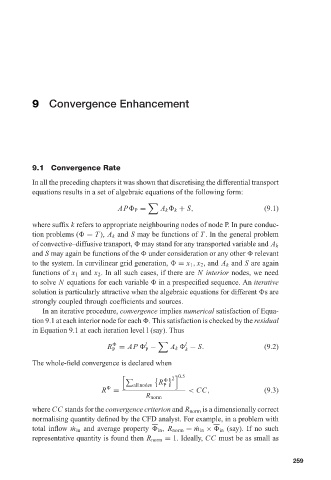
                                                 AP  P =      A k   k + S,                  (9.1)

                        where suffix k refers to appropriate neighbouring nodes of node P. In pure conduc-
                        tion problems (  = T ), A k and S may be functions of T . In the general problem

                        of convective–diffusive transport,   may stand for any transported variable and A k
                        and S may again be functions of the   under consideration or any other   relevant
                        to the system. In curvilinear grid generation,   = x 1 , x 2 , and A k and S are again
                        functions of x 1 and x 2 . In all such cases, if there are N interior nodes, we need
                        to solve N equations for each variable   in a prespecified sequence. An iterative
                        solution is particularly attractive when the algebraic equations for different  s are
                        strongly coupled through coefficients and sources.
                           In an iterative procedure, convergence implies numerical satisfaction of Equa-
                        tion 9.1 at each interior node for each  . This satisfaction is checked by the residual
                        in Equation 9.1 at each iteration level l (say). Thus
                                                         l           l
                                              R = AP   −         A k   − S.                 (9.2)
                                                P        P           k
                        The whole-field convergence is declared when

                                                   )              * 0.5
                                                                    2
                                                             R
                                                      all nodes  P

                                             R =                      < CC,                 (9.3)
                                                         R norm
                        where CC stands for the convergence criterion and R norm is a dimensionally correct
                        normalising quantity defined by the CFD analyst. For example, in a problem with
                        total inflow ˙ m in and average property   in , R norm = ˙ m in ×   in (say). If no such
                        representative quantity is found then R norm = 1. Ideally, CC must be as small as


                                                                                                    259

