


Page 628 - Introduction to Information Optics
P. 628
612                       10. Sensing with Optics

       results obtained with conventional resistant strain gauges [44]. Thus, indeed,
       fiber Bragg grating-based quasi-distributed fiber sensors may be used in
       real-world sensing.


          10.3.2.1.4. Multiple-Parameter Measurements Using Fiber Bragg
                   Gratings Written in Highly Birefringent
                   Polarization-Preserving Fibers
          In real-world applications, strain and temperature perturbations may add
       to the fiber Bragg gratings simultaneously. To avoid the use of additional
       sensors to separate influence from strain and temperature changes, the tech-
       niques of using double Bragg gratings written at widely spaced wavelengths at
       the same location in a polarization-maintaining (PM) fiber were developed
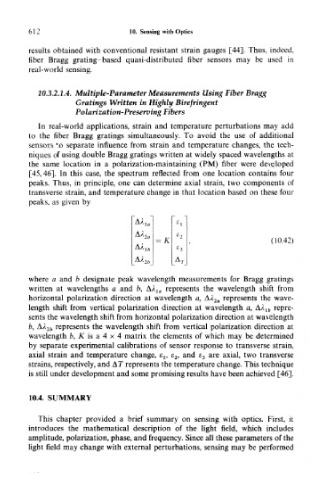
       [45,46]. In this case, the spectrum reflected from one location contains four
       peaks. Thus, in principle, one can determine axial strain, two components of
       transverse strain, and temperature change in that location based on these four
       peaks, as given by


                                       = K                          (10.42)
                                  Ax
                                            A

       where a and b designate peak wavelength measurements for Bragg gratings
       written at wavelengths a and b, A/l la represents the wavelength shift from
       horizontal polarization direction at wavelength a, AA 2a represents the wave-
       length shift from vertical polarization direction at wavelength a, A/t lb repre-
       sents the wavelength shift from horizontal polarization direction at wavelength
       b, Al 2fc represents the wavelength shift from vertical polarization direction at
       wavelength b, K is a 4 x 4 matrix the elements of which may be determined
       by separate experimental calibrations of sensor response to transverse strain,
       axial strain and temperature change, e^ e 2, and % are axial, two transverse
       strains, respectively, and AT represents the temperature change. This technique
       is still under development and some promising results have been achieved [46].


       10.4. SUMMARY

          This chapter provided a brief summary on sensing with optics. First, it
       introduces the mathematical description of the light field, which includes
       amplitude, polarization, phase, and frequency. Since all these parameters of the
       light field may change with external perturbations, sensing may be performed

