


Page 635 - Introduction to Information Optics
P. 635
S 1.2. Information Display Using Acousto-Optic Spatial Light Modulators  619

                                  (b)                Q
                                                     4
                                    CO


                                                              A


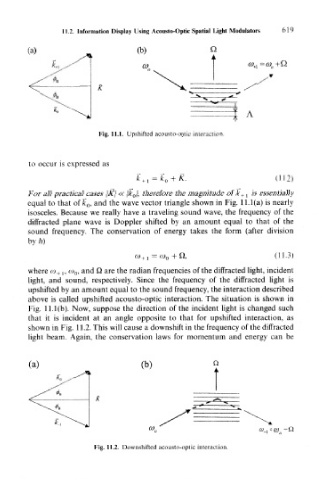
                        Fig. 11.1. Upshifted acousto-optic interaction.


       to occur is expressed as
                                             K.                      (11.2)

       For all practical cases |K| « |fc 0|, therefore the magnitude of k  + 1 is essentially
       equal to that of Ic 0, and the wave vector triangle shown in Fig. 11.1 (a) is nearly
       isosceles. Because we really have a traveling sound wave, the frequency of the
       diffracted plane wave is Doppler shifted by an amount equal to that of the
       sound frequency. The conservation of energy takes the form (after division
       by h]

                                  (O.  = io n + Q,                   (11.3)
       where to +1, co 0, and Q are the radian frequencies of the diffracted light, incident
       light, and sound, respectively. Since the frequency of the diffracted light is
       upshifted by an amount equal to the sound frequency, the interaction described
       above is called upshifted acousto-optic interaction. The situation is shown in
       Fig. ll.l(b). Now, suppose the direction of the incident light is changed such
       that it is incident at an angle opposite to that for upshifted interaction, as
       shown in Fig. 11.2. This will cause a downshift in the frequency of the diffracted
       light beam. Again, the conservation laws for momentum and energy can be


                                   (b)


                                                                 CO. =6J -Q

                        Fig. 11.2. Downshifted acousto-optic interaction.

