


Page 637 - Introduction to Information Optics
P. 637
11.2. Information Display Using Acousto-Optic Spatial Light Modulators  62:


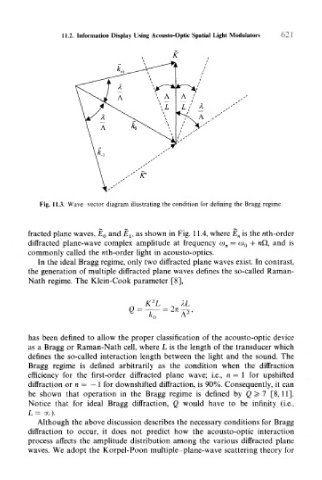
          Fig. 11.3. Wave -vector diagram illustrating the condition for defining the Bragg regime.


       fracted plane waves, E 0 and £ t , as shown in Fig. 11.4, where E n is the nth-order
       diffracted plane-wave complex amplitude at frequency co n = o> 0 + nQ, and is
       commonly called the nth-order light in acousto-optics.
         In the ideal Bragg regime, only two diffracted plane waves exist. In contrast,
       the generation of multiple diffracted plane waves defines the so-called Raman-
       Nath regime. The Klein-Cook parameter [8],


                                0  = _~  = 27i'— 2
                                ^    k n     A '

       has been defined to allow the proper classification of the acousto-optic device
       as a Bragg or Raman-Nath cell, where L is the length of the transducer which
       defines the so-called interaction length between the light and the sound. The
       Bragg regime is defined arbitrarily as the condition when the diffraction
       efficiency for the first-order diffracted plane wave; i.e., n — \ for upshifted
       diffraction or n = — 1 for downshifted diffraction, is 90%. Consequently, it can
       be shown that operation in the Bragg regime is defined by Q ^ 7 [8,11].
       Notice that for ideal Bragg diffraction, Q would have to be infinity (i.e.,
       L = oo).
         Although the above discussion describes the necessary conditions for Bragg
       diffraction to occur, it does not predict how the acousto-optic interaction
       process affects the amplitude distribution among the various diffracted plane
       waves. We adopt the Korpel-Poon multiple-plane-wave scattering theory for

