


Page 199 - Introduction to Mineral Exploration
P. 199
182   C.J. MOON & M.K.G. WHATELEY


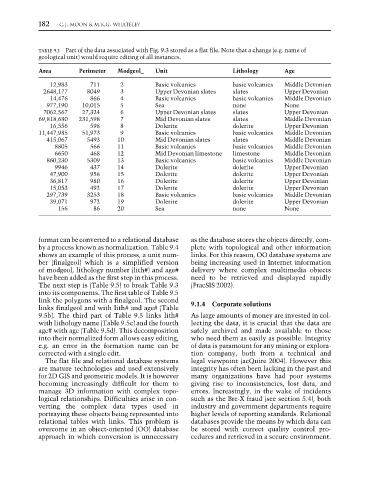
                  TABLE 9.3 Part of the data associated with Fig. 9.3 stored as a flat file. Note that a change (e.g. name of
                  geological unit) would require editing of all instances.

                  Area        Perimeter  Modgeol_   Unit                  Lithology      Age
                     12,983      711      2         Basic volcanics       basic volcanics  Middle Devonian
                   2648,177     8049      3         Upper Devonian slates  slates        Upper Devonian
                     14,476      866      4         Basic volcanics       basic volcanics  Middle Devonian
                    977,190    10,015     5         Sea                   none           None
                   7062,567    27,324     6         Upper Devonian slates  slates        Upper Devonian
                  69,818,680  231,598     7         Mid Devonian slates   slates         Middle Devonian
                     16,556      598      8         Dolerite              dolerite       Upper Devonian
                  11,447,985   51,973     9         Basic volcanics       basic volcanics  Middle Devonian
                    415,067     5493     10         Mid Devonian slates   slates         Middle Devonian
                       8805      566     11         Basic volcanics       basic volcanics  Middle Devonian
                       6650      468     12         Mid Devonian limestone  limestone    Middle Devonian
                    860,230     5309     13         Basic volcanics       basic volcanics  Middle Devonian
                       9946      437     14         Dolerite              dolerite       Upper Devonian
                     47,900      958     15         Dolerite              dolerite       Upper Devonian
                     36,817      980     16         Dolerite              dolerite       Upper Devonian
                     15,053      492     17         Dolerite              dolerite       Upper Devonian
                    297,739     3253     18         Basic volcanics       basic volcanics  Middle Devonian
                     39,071      972     19         Dolerite              dolerite       Upper Devonian
                       156        86     20         Sea                   none           None


                  format can be converted to a relational database  as the database stores the objects directly, com-
                  by a process known as normalization. Table 9.4  plete with topological and other information
                  shows an example of this process, a unit num-  links. For this reason, OO database systems are
                  ber (finalgeol) which is a simplified version  being increasing used in Internet information
                  of modgeol, lithology number (lith#) and age#  delivery where complex multimedia objects
                  have been added as the first step in this process.  need to be retrieved and displayed rapidly
                  The next step is (Table 9.5) to break Table 9.3  (FracSIS 2002).
                  into its components. The first table of Table 9.5
                  link the polygons with a finalgeol. The second
                  links finalgeol and with lith# and age# (Table  9.1.4 Corporate solutions
                  9.5b). The third part of Table 9.5 links lith#  As large amounts of money are invested in col-
                  with lithology name (Table 9.5c) and the fourth  lecting the data, it is crucial that the data are
                  age# with age (Table 9.5d). This decomposition  safely archived and made available to those
                  into their normalized form allows easy editing,  who need them as easily as possible. Integrity
                  e.g. an error in the formation name can be  of data is paramount for any mining or explora-
                  corrected with a single edit.               tion company, both from a technical and
                    The flat file and relational database systems  legal viewpoint (acQuire 2004). However this
                  are mature technologies and used extensively  integrity has often been lacking in the past and
                  for 2D GIS and geometric models. It is however  many organizations have had poor systems
                  becoming increasingly difficult for them to  giving rise to inconsistencies, lost data, and
                  manage 3D information with complex topo-    errors. Increasingly, in the wake of incidents
                  logical relationships. Difficulties arise in con-  such as the Bre-X fraud (see section 5.4), both
                  verting the complex data types used in      industry and government departments require
                  portraying these objects being represented into  higher levels of reporting standards. Relational
                  relational tables with links. This problem is  databases provide the means by which data can
                  overcome in an object-oriented (OO) database  be stored with correct quality control pro-
                  approach in which conversion is unnecessary  cedures and retrieved in a secure environment.

