


Page 204 - Introduction to Mineral Exploration
P. 204
9: MINERAL EXPLORATION DATA  187


                 9.2.2 South Devon example                      The area discussed is on the southern flank
                                                              of one of the major early Permian granite in-
                 Perhaps the best way of explaining the methods  trusives, the Dartmoor Granite. This granite
                 of handling data in a GIS is to use a worked  intrudes an area generally of low grade marginal
                 example. This example is typical of early stage  marine and fluvial sediments with interbedded
                 exploration and refers to an area in south   volcanics of Devonian age that were deformed
                 Devon, England. Prior to the mid 1980s this  during the late Carboniferous. The Devonian
                 area was not thought prospective for gold and  sediments (and originally the granite) are
                 no systematic exploration had been under-    unconformably overlain by red-bed sandstones
                 taken. The British Geological Survey had long  and fine sediments of Permo-Triassic age.
                 been active in the area and had investigated the  Marine sediments of Jurassic and Cretaceous
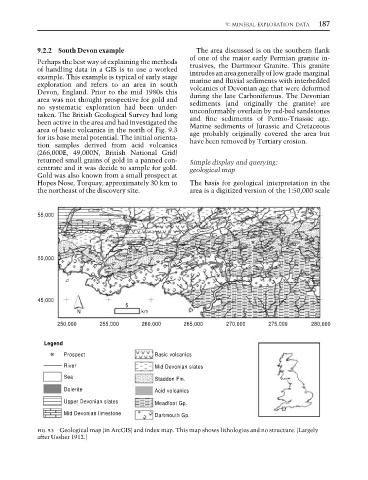
                 area of basic volcanics in the north of Fig. 9.3  age probably originally covered the area but
                 for its base metal potential. The initial orienta-  have been removed by Tertiary erosion.
                 tion samples derived from acid volcanics
                 (266,000E, 49,000N, British National Grid)
                 returned small grains of gold in a panned con-  Simple display and querying:
                 centrate and it was decide to sample for gold.  geological map
                 Gold was also known from a small prospect at
                 Hopes Nose, Torquay, approximately 30 km to  The basis for geological interpretation in the
                 the northeast of the discovery site.         area is a digitized version of the 1:50,000 scale


                  55,000


                  50,000


                  45,000
                                           5
                             N                  km
                       250,000      255,000     260,000     265,000      270,000     275,000     280,000


                   Legend
                         Prospect                   Basic volcanics
                         River                      Mid Devonian slates
                         Sea
                                                    Staddon Fm.
                         Dolerite                   Acid volcanics
                         Upper Devonian slates      Meadfoot Gp.
                         Mid Devonian limestone     Dartmouth Gp.

                 FIG. 9.3 Geological map (in ArcGIS) and index map. This map shows lithologies and no structure. (Largely
                 after Ussher 1912.)

