


Page 206 - Introduction to Mineral Exploration
P. 206
9: MINERAL EXPLORATION DATA  189


                  55,000


                  50,000


                  45,000


                       250,000      255,000     260,000     265,000     270,000      275,000     280,000

                                         10
                                                      km                    Prospect
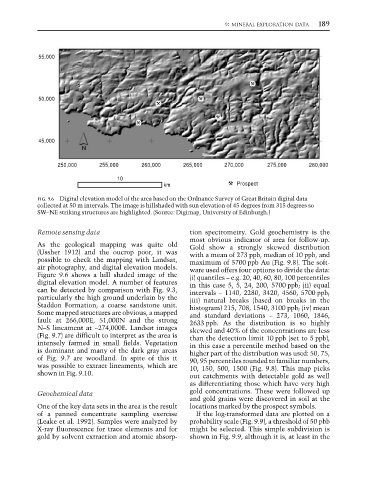
                 FIG. 9.6  Digital elevation model of the area based on the Ordnance Survey of Great Britain digital data
                 collected at 50 m intervals. The image is hillshaded with sun elevation of 45 degrees from 315 degrees so
                 SW–NE striking structures are highlighted. (Source: Digimap, University of Edinburgh.)

                 Remote sensing data                          tion spectrometry. Gold geochemistry is the
                                                              most obvious indicator of area for follow-up.
                 As the geological mapping was quite old      Gold show a strongly skewed distribution
                 (Ussher 1912) and the oucrop poor, it was    with a mean of 273 ppb, median of 10 ppb, and
                 possible to check the mapping with Landsat,  maximum of 5700 ppb Au (Fig. 9.8). The soft-
                 air photography, and digital elevation models.  ware used offers four options to divide the data:
                 Figure 9.6 shows a hill shaded image of the  (i) quantiles – e.g. 20, 40, 60, 80, 100 percentiles
                 digital elevation model. A number of features  in this case 5, 5, 24, 200, 5700 ppb; (ii) equal
                 can be detected by comparison with Fig. 9.3,  intervals – 1140, 2280, 3420, 4560, 5700 ppb;
                 particularly the high ground underlain by the  (iii) natural breaks (based on breaks in the
                 Staddon Formation, a coarse sandstone unit.  histogram) 215, 708, 1540, 3100 ppb; (iv) mean
                 Some mapped structures are obvious, a mapped  and standard deviations – 273, 1060, 1846,
                 fault at 266,000E, 51,000N and the strong    2633 ppb. As the distribution is so highly
                 N–S lineament at ~274,000E. Landsat images   skewed and 40% of the concentrations are less
                 (Fig. 9.7) are difficult to interpret as the area is  than the detection limit 10 ppb (set to 5 ppb),
                 intensely farmed in small fields. Vegetation  in this case a percentile method based on the
                 is dominant and many of the dark gray areas  higher part of the distribution was used: 50, 75,
                 of Fig. 9.7 are woodland. In spite of this it  90, 95 percentiles rounded to familiar numbers,
                 was possible to extract lineaments, which are  10, 150, 500, 1500 (Fig. 9.8). This map picks
                 shown in Fig. 9.10.                          out catchments with detectable gold as well
                                                              as differentiating those which have very high
                 Geochemical data                             gold concentrations. These were followed up
                                                              and gold grains were discovered in soil at the
                 One of the key data sets in the area is the result  locations marked by the prospect symbols.
                 of a panned concentrate sampling exercise      If the log-transformed data are plotted on a
                 (Leake et al. 1992). Samples were analyzed by  probability scale (Fig. 9.9), a threshold of 50 pbb
                 X-ray fluorescence for trace elements and for  might be selected. This simple subdivision is
                 gold by solvent extraction and atomic absorp-  shown in Fig. 9.9, although it is, at least in the

