


Page 208 - Introduction to Mineral Exploration
P. 208
9: MINERAL EXPLORATION DATA  191


                  55,000


                  50,000


                  45,000
                                       5
                                              km
                         N
                        250,000     255,000     260,000     265,000     270,000      275,000     280,000


                                                         3.59
                                                                                            2
                          Legend
                                Prospect         log 10  2.26                               1
                                                Au (ppb)
                                River                     .93
                                                                                            0
                          Au ppb
                                                         –.4                               –1
                                0.5–50
                                                         –1.74                             –2
                                50–5700
                                                             0   10   30  50  70  90  98
                                                                 percentiles (probability scale)

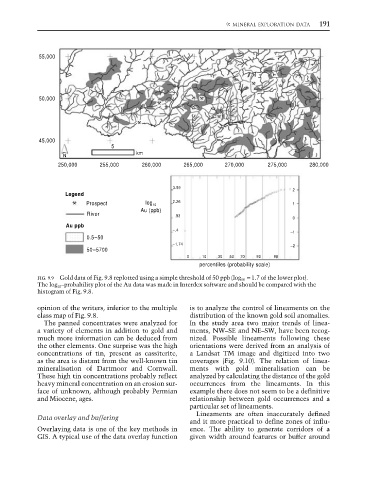
                 FIG. 9.9 Gold data of Fig. 9.8 replotted using a simple threshold of 50 ppb (log 10     = 1.7 of the lower plot).
                 The log 10 –probability plot of the Au data was made in Interdex software and should be compared with the
                 histogram of Fig. 9.8.

                 opinion of the writers, inferior to the multiple  is to analyze the control of lineaments on the
                 class map of Fig. 9.8.                       distribution of the known gold soil anomalies.
                   The panned concentrates were analyzed for  In the study area two major trends of linea-
                 a variety of elements in addition to gold and  ments, NW–SE and NE–SW, have been recog-
                 much more information can be deduced from    nized. Possible lineaments following these
                 the other elements. One surprise was the high  orientations were derived from an analysis of
                 concentrations of tin, present as cassiterite,  a Landsat TM image and digitized into two
                 as the area is distant from the well-known tin  coverages (Fig. 9.10). The relation of linea-
                 mineralisation of Dartmoor and Cornwall.     ments with gold mineralisation can be
                 These high tin concentrations probably reflect  analyzed by calculating the distance of the gold
                 heavy mineral concentration on an erosion sur-  occurrences from the lineaments. In this
                 face of unknown, although probably Permian   example there does not seem to be a definitive
                 and Miocene, ages.                           relationship between gold occurrences and a
                                                              particular set of lineaments.
                                                                Lineaments are often inaccurately defined
                 Data overlay and buffering
                                                              and it more practical to define zones of influ-
                 Overlaying data is one of the key methods in  ence. The ability to generate corridors of a
                 GIS. A typical use of the data overlay function  given width around features or buffer around

