


Page 243 - Introduction to Mineral Exploration
P. 243
226   M.K.G. WHATELEY & B. SCOTT


                                  1
                      253.66 m    Sample


                                        2
                                   40°       Fragment missing
                       15 cm
                      Slate
                                                 3       Chlorite and
                                        5 cm core loss   ore minerals
                             15 cm
                  hanging–wall
                                                         Chlorite and quartz

                                                           4
                                       31 cm

                                    Lode zone
                                                                   5
                                                15 cm
                           Chlorite and feldspar


                                                        23 cm
                                                                254.65 m
                  Core intersection angle average 40°
                                                  Slate footwall
                   Sample    Depth       Recovery   True width  %Sn  cm%
                   number  from(m) to(m)  (m)  (%)    (cm)
                     1    253.66  253.81  0.15  100    12    0.03  0.36
                     2    253.81 253.96  0.15  100     12    0.56  6.72
                     3    253.96 254.27  0.25  81      20    4.75  95.00
                     4    254.27 254.42  0.15  100     12    1.27  15.24
                     5    254.42 254.65  0.23  100     18     NIL   –
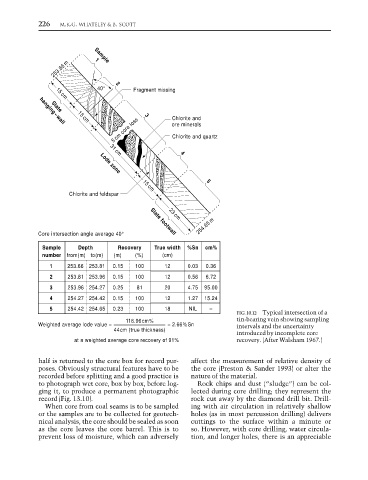
                                                                            FIG. 10.12  Typical intersection of a
                  Weighted average lode value =  116.96cm%  = 2.66%Sn       tin-bearing vein showing sampling
                                                                            intervals and the uncertainty
                                        44cm (true thickness)
                                                                            introduced by incomplete core
                            at a weighted average core recovery of 91%      recovery. (After Walsham 1967.)
                  half is returned to the core box for record pur-  affect the measurement of relative density of
                  poses. Obviously structural features have to be  the core (Preston & Sander 1993) or alter the
                  recorded before splitting and a good practice is  nature of the material.
                  to photograph wet core, box by box, before log-  Rock chips and dust (“sludge”) can be col-
                  ging it, to produce a permanent photographic  lected during core drilling; they represent the
                  record (Fig. 13.10).                        rock cut away by the diamond drill bit. Drill-
                    When core from coal seams is to be sampled  ing with air circulation in relatively shallow
                  or the samples are to be collected for geotech-  holes (as in most percussion drilling) delivers
                  nical analysis, the core should be sealed as soon  cuttings to the surface within a minute or
                  as the core leaves the core barrel. This is to  so. However, with core drilling, water circula-
                  prevent loss of moisture, which can adversely  tion, and longer holes, there is an appreciable

