


Page 239 - Introduction to Mineral Exploration
P. 239
222   M.K.G. WHATELEY & B. SCOTT


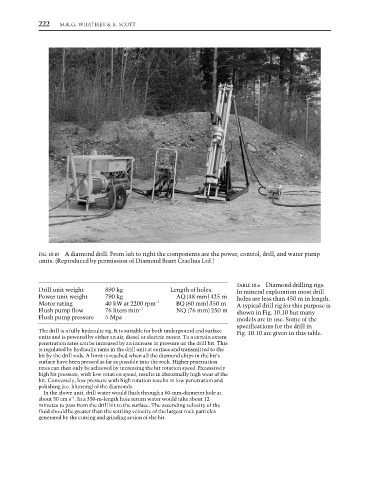
                  FIG. 10.10  A diamond drill. From left to right the components are the power, control, drill, and water pump
                  units. (Reproduced by permission of Diamond Boart Craelius Ltd.)


                                                                            TABLE 10.6 Diamond drilling rigs.
                  Drill unit weight  890 kg             Length of holes:    In mineral exploration most drill
                  Power unit weight  790 kg               AQ (48 mm) 425 m  holes are less than 450 m in length.
                  Motor rating       40 kW at 2200 rpm −1  BQ (60 mm) 350 m  A typical drill rig for this purpose is
                  Flush pump flow     76 liters min −1     NQ (76 mm) 250 m  shown in Fig. 10.10 but many
                  Flush pump pressure  5 Mpa                                models are in use. Some of the
                                                                            specifications for the drill in
                  The drill is a fully hydraulic rig. It is suitable for both underground and surface  Fig. 10.10 are given in this table.
                  units and is powered by either an air, diesel or electric motor. To a certain extent
                  penetration rates can be increased by an increase in pressure on the drill bit. This
                  is regulated by hydraulic rams in the drill unit at surface and transmitted to the
                  bit by the drill rods. A limit is reached when all the diamond chips in the bit’s
                  surface have been pressed as far as possible into the rock. Higher penetration
                  rates can then only be achieved by increasing the bit rotation speed. Excessively
                  high bit pressure, with low rotation speed, results in abnormally high wear of the
                  bit. Conversely, low pressure with high rotation results in low penetration and
                  polishing (i.e. blunting) of the diamonds.
                   In the above unit, drill water would flush through a 60-mm-diameter hole at
                           −1
                  about 50 cm s . In a 350-m-length hole return water would take about 12
                  minutes to pass from the drill bit to the surface. The ascending velocity of the
                  fluid should be greater than the settling velocity of the largest rock particles
                  generated by the cutting and grinding action of the bit.

