


Page 234 - Introduction to Mineral Exploration
P. 234
10: EVALUATION TECHNIQUES  217


                 available in all exploration offices and must be  being outside the range is higher – four chances
                 read and understood. Samplers should rarely,  in 20 or quadruple the previous calculation.
                 if ever, work alone and visits to mine work-   Commonsense must be used in the inter-
                 ings (surface or underground) should be accom-  pretation of the results of any sampling pro-
                 panied. Visits to abandoned mine workings    gram and particularly with the problem of
                 need particular care and the workings should  re-sampling in order to increase the n statistic.
                 be assessed fully for potential weak rock    As an example, a zinc prospect 200 km from
                 conditions, weak roof support, water extent,  the nearest road or railway is sampled and
                 noxious gases, and other hazards before samp-  preliminary estimates are 2.1% zinc with an
                 ling commences.                              estimated overall reserve tonnage of about
                                                              200,000 t. There is no point in sharpening this
                                                              grade estimate by taking more samples as the
                 After sampling
                                                              low tonnage, approximate grade and location
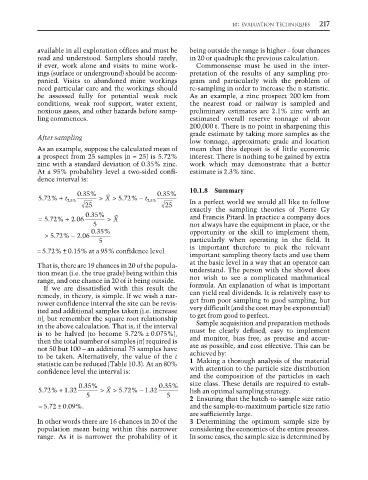
                 As an example, suppose the calculated mean of  mean that this deposit is of little economic
                 a prospect from 25 samples (n = 25) is 5.72%  interest. There is nothing to be gained by extra
                 zinc with a standard deviation of 0.35% zinc.  work which may demonstrate that a better
                 At a 95% probability level a two-sided confi-  estimate is 2.3% zinc.
                 dence interval is:
                                                              10.1.8  Summary
                                                     .
                              .
                             035%                   035%
                                       >
                                   >
                                     Y
                   .
                  572% + t 25.%          .        25.%        In a perfect world we would all like to follow
                                         572%   − t
                               25                      25     exactly the sampling theories of Pierre Gy
                                 . 035 %
                     .
                  = 572 %  + 2 .06    >   Y                   and Francis Pitard. In practice a company does
                                  5                           not always have the equipment in place, or the
                                  . 035 %                     opportunity or the skill to implement them,
                      .
                    > 572 %  − 2 .06
                                   5                          particularly when operating in the field. It
                                                              is important therefore to pick the relevant
                 = 5.72% ± 0.15% at a 95% confidence level
                                                              important sampling theory facts and use them
                                                              at the basic level in a way that an operator can
                 That is, there are 19 chances in 20 of the popula-
                 tion mean (i.e. the true grade) being within this  understand. The person with the shovel does
                 range, and one chance in 20 of it being outside.  not wish to see a complicated mathmatical
                   If we are dissatisfied with this result the  formula. An explanation of what is important
                 remedy, in theory, is simple. If we wish a nar-  can yield real dividends. It is relatively easy to
                 rower confidence interval the site can be revis-  get from poor sampling to good sampling, but
                 ited and additional samples taken (i.e. increase  very difficuilt (and the cost may be exponential)
                 n), but remember the square root relationship  to get from good to perfect.
                 in the above calculation. That is, if the interval  Sample acquisition and preparation methods
                 is to be halved (to become 5.72% ± 0.075%),  must be clearly defined, easy to implement
                 then the total number of samples (n) required is  and monitor, bias free, as precise and accur-
                 not 50 but 100 – an additional 75 samples have  ate as possible, and cost effective. This can be
                 to be taken. Alternatively, the value of the t  achieved by:
                 statistic can be reduced (Table 10.3). At an 80%  1 Making a thorough analysis of the material
                 confidence level the interval is:             with attention to the particle size distribution
                                                              and the composition of the particles in each
                              035%                   035%     size class. These details are required to estab-
                                                      .
                               .
                  572% +  1 32      > Y  >  572% −  1 32      lish an optimal sampling strategy.
                   .
                                                  .
                                          .
                          .
                                5                      5      2 Ensuring that the batch-to-sample size ratio
                  = 5.72 ± 0.09%.                             and the sample-to-maximum particle size ratio
                                                              are sufficiently large.
                 In other words there are 16 chances in 20 of the  3 Determining the optimum sample size by
                 population mean being within this narrower   considering the economics of the entire process.
                 range. As it is narrower the probability of it  In some cases, the sample size is determined by

