


Page 233 - Introduction to Mineral Exploration
P. 233
216   M.K.G. WHATELEY & B. SCOTT


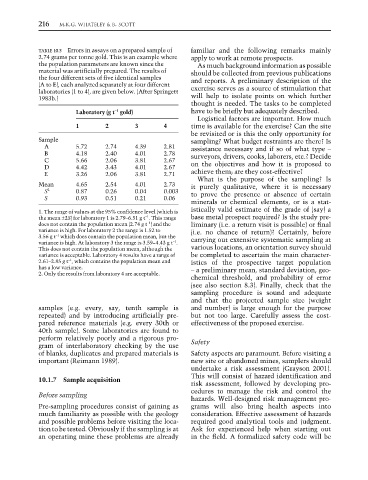
                  TABLE 10.5 Errors in assays on a prepared sample of  familiar and the following remarks mainly
                  2.74 grams per tonne gold. This is an example where  apply to work at remote prospects.
                  the population parameters are known since the  As much background information as possible
                  material was artificially prepared. The results of  should be collected from previous publications
                  the four different sets of five identical samples  and reports. A preliminary description of the
                  (A to E), each analyzed separately at four different  exercise serves as a source of stimulation that
                  laboratories (1 to 4), are given below. (After Springett
                  1983b.)                                     will help to isolate points on which further
                                                              thought is needed. The tasks to be completed
                                        − − − − −1
                             Laboratory (g t  gold)           have to be briefly but adequately described.
                                                                Logistical factors are important. How much
                             1       2        3       4       time is available for the exercise? Can the site
                                                              be revisited or is this the only opportunity for
                  Sample                                      sampling? What budget restraints are there? Is
                    A        5.72    2.74     4.39    2.81    assistance necessary and if so of what type –
                    B        4.18    2.40     4.01    2.78    surveyors, drivers, cooks, laborers, etc.? Decide
                    C        5.66    2.06     3.81    2.67    on the objectives and how it is proposed to
                    D        4.42    3.43     4.01    2.67
                    E        3.26    2.06     3.81    2.71    achieve them; are they cost-effective?
                                                                What is the purpose of the sampling? Is
                  Mean       4.65    2.54     4.01    2.73    it purely qualitative, where it is necessary
                    S 2      0.87    0.26     0.04    0.003   to prove the presence or absence of certain
                    S        0.93    0.51     0.21    0.06
                                                              minerals or chemical elements, or is a stat-
                  1. The range of values at the 95% confidence level (which is  istically valid estimate of the grade of (say) a
                  the mean ±2S) for laboratory 1 is 2.79–6.51 g t . This range  base metal prospect required? Is the study pre-
                                                 −1
                  does not contain the population mean (2.74 g t ) and the  liminary (i.e. a return visit is possible) or final
                                                 −1
                  variance is high. For laboratory 2 the range is 1.52 to  (i.e. no chance of return)? Certainly, before
                  3.56 g t  which does contain the population mean, but the
                       −1
                                                         −1
                  variance is high. At laboratory 3 the range is 3.59–4.43 g t .  carrying out extensive systematic sampling at
                  This does not contain the population mean, although the  various locations, an orientation survey should
                  variance is acceptable. Laboratory 4 results have a range of  be completed to ascertain the main character-
                  2.61–2.85 g t , which contains the population mean and  istics of the prospective target population
                          −1
                  has a low variance.                         – a preliminary mean, standard deviation, geo-
                  2. Only the results from laboratory 4 are acceptable.
                                                              chemical threshold, and probability of error
                                                              (see also section 8.3). Finally, check that the
                                                              sampling procedure is sound and adequate
                                                              and that the projected sample size (weight
                  samples (e.g. every, say, tenth sample is   and number) is large enough for the purpose
                  repeated) and by introducing artificially pre-  but not too large. Carefully assess the cost-
                  pared reference materials (e.g. every 30th or  effectiveness of the proposed exercise.
                  40th sample). Some laboratories are found to
                  perform relatively poorly and a rigorous pro-
                  gram of interlaboratory checking by the use  Safety
                  of blanks, duplicates and prepared materials is  Safety aspects are paramount. Before visiting a
                  important (Reimann 1989).                   new site or abandoned mines, samplers should
                                                              undertake a risk assessment (Grayson 2001).
                                                              This will consist of hazard identification and
                  10.1.7  Sample acquisition
                                                              risk assessment, followed by developing pro-
                                                              cedures to manage the risk and control the
                  Before sampling
                                                              hazards. Well-designed risk management pro-
                  Pre-sampling procedures consist of gaining as  grams will also bring health aspects into
                  much familiarity as possible with the geology  consideration. Effective assessment of hazards
                  and possible problems before visiting the loca-  required good analytical tools and judgment.
                  tion to be tested. Obviously if the sampling is at  Ask for experienced help when starting out
                  an operating mine these problems are already  in the field. A formalized safety code will be

