


Page 230 - Introduction to Mineral Exploration
P. 230
10: EVALUATION TECHNIQUES  213


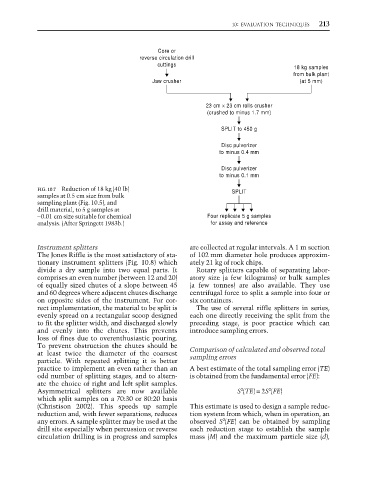
                                                     Core or
                                               reverse circulation drill
                                                    cuttings
                                                                                            18 kg samples
                                                                                            from bulk plant
                                                   Jaw crusher                                (at 5 mm)


                                                                   23 cm × 23 cm rolls crusher
                                                                   (crushed to minus 1.7 mm)
                                                                       SPLIT to 450 g


                                                                       Disc pulverizer
                                                                       to minus 0.4 mm

                                                                       Disc pulverizer
                                                                       to minus 0.1 mm
                 FIG. 10.7 Reduction of 18 kg (40 lb)                     SPLIT
                 samples at 0.5 cm size from bulk
                 sampling plant (Fig. 10.5), and
                 drill material, to 5 g samples at
                 −0.01 cm size suitable for chemical               Four replicate 5 g samples
                 analysis. (After Springett 1983b.)                 for assay and reference


                 Instrument splitters                         are collected at regular intervals. A 1 m section
                 The Jones Riffle is the most satisfactory of sta-  of 102 mm diameter hole produces approxim-
                 tionary instrument splitters (Fig. 10.8) which  ately 21 kg of rock chips.
                 divide a dry sample into two equal parts. It   Rotary splitters capable of separating labor-
                 comprises an even number (between 12 and 20)  atory size (a few kilograms) or bulk samples
                 of equally sized chutes of a slope between 45  (a few tonnes) are also available. They use
                 and 60 degrees where adjacent chutes discharge  centrifugal force to split a sample into four or
                 on opposite sides of the instrument. For cor-  six containers.
                 rect implementation, the material to be split is  The use of several riffle splitters in series,
                 evenly spread on a rectangular scoop designed  each one directly receiving the split from the
                 to fit the splitter width, and discharged slowly  preceding stage, is poor practice which can
                 and evenly into the chutes. This prevents    introduce sampling errors.
                 loss of fines due to overenthusiastic pouring.
                 To prevent obstruction the chutes should be
                 at least twice the diameter of the coarsest  Comparison of calculated and observed total
                 particle. With repeated splitting it is better  sampling errors
                 practice to implement an even rather than an  A best estimate of the total sampling error (TE)
                 odd number of splitting stages, and to altern-  is obtained from the fundamental error (FE):
                 ate the choice of right and left split samples.
                                                                             2
                                                                                     2
                 Asymmetrical splitters are now available                   S (TE) = 2S (FE)
                 which split samples on a 70:30 or 80:20 basis
                 (Christison 2002). This speeds up sample     This estimate is used to design a sample reduc-
                 reduction and, with fewer separations, reduces  tion system from which, when in operation, an
                                                                        2
                 any errors. A sample splitter may be used at the  observed  S (FE) can be obtained by sampling
                 drill site especially when percussion or reverse  each reduction stage to establish the sample
                 circulation drilling is in progress and samples  mass (M) and the maximum particle size (d),

