


Page 229 - Introduction to Mineral Exploration
P. 229
212   M.K.G. WHATELEY & B. SCOTT


                        36.2 tonnes (80,000 lb)
                            bulk sample


                  18.1 tonnes for      18.1 tonnes
                    test work     crushed to minus 32 mm
                                                  32 mm screen

                                  ROTARY SPLITTER (4:1)


                               14.5 tonnes       3.6 tonnes
                                            crushed to minus 10 mm
                                                             10 mm screen

                                                 SPLIT


                                        3020 kg          580 kg

                                                     23 cm × 30 cm roll
                                                   crusher to minus 5 mm


                                                         SPLIT


                                                 Rejects          72 kg
                                                 446 kg

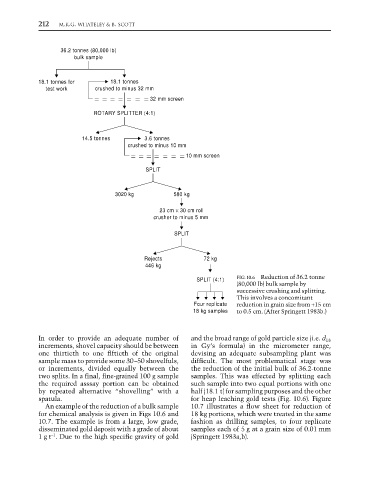
                                                                SPLIT (4:1)  FIG. 10.6  Reduction of 36.2 tonne
                                                                            (80,000 lb) bulk sample by
                                                                            successive crushing and splitting.
                                                                            This involves a concomitant
                                                               Four replicate  reduction in grain size from +15 cm
                                                               18 kg samples  to 0.5 cm. (After Springett 1983b.)


                  In order to provide an adequate number of   and the broad range of gold particle size (i.e. d lib
                  increments, shovel capacity should be between  in Gy’s formula) in the micrometer range,
                  one thirtieth to one fiftieth of the original  devising an adequate subsampling plant was
                  sample mass to provide some 30–50 shovelfuls,  difficult. The most problematical stage was
                  or increments, divided equally between the  the reduction of the initial bulk of 36.2-tonne
                  two splits. In a final, fine-grained 100 g sample  samples. This was effected by splitting each
                  the required asssay portion can be obtained  such sample into two equal portions with one
                  by repeated alternative “shovelling” with a  half (18.1 t) for sampling purposes and the other
                  spatula.                                    for heap leaching gold tests (Fig. 10.6). Figure
                    An example of the reduction of a bulk sample  10.7 illustrates a flow sheet for reduction of
                  for chemical analysis is given in Figs 10.6 and  18 kg portions, which were treated in the same
                  10.7. The example is from a large, low grade,  fashion as drilling samples, to four replicate
                  disseminated gold deposit with a grade of about  samples each of 5 g at a grain size of 0.01 mm
                      −1
                  1gt . Due to the high specific gravity of gold  (Springett 1983a,b).

