


Page 225 - Introduction to Mineral Exploration
P. 225
208   M.K.G. WHATELEY & B. SCOTT


                  tend to collect the finer particles as they are  grams of material (the assay portion) selected
                  invariably taken from the top part of any heap.  from several kilograms or tonnes of sample(s).
                  The larger, usually less mineralized particles  Consequently, after collection, sampling in-
                  roll down to the base of the perimeter and are  volves a systematic reduction of mass and grain
                  not sampled. When creating a channel, mater-  size as an inevitable prerequisite to analysis.
                  ial will always collapse into the void. Thus, the  This reduction is of the order of 1000 times
                  top of the heap is sampled. Similarly, in an  with a kilogram sample and 1,000,000 with a
                  upward scoop, the scoop is usually full before  tonne sample.
                  it gets anywhere near the top of the channel.  Samples are reduced by crushing and grind-
                  When forcing a pipe sampler into a pile of  ing and the resultant finer grained material is
                  material, the pipe preferentially collects the  split, or separated, into discrete mass compon-
                  top 6 inches (15 cm) of the material and then  ents for further reduction (Geelhoed & Glass
                  blocks.                                     2001). A sample reduction system is a sequence
                  3 Grab sample analyses also gave higher results  of stages that progressively substitutes a series
                  than the 100% sample.                       of smaller and smaller samples from the ori-
                                                              ginal until the assay portion is obtained for
                                                              chemical analysis. Such a system is essentially
                  10.1.4  Sample preparation
                                                              an alternation of size and mass reduction stages
                  The ultimate purpose of sampling is to estim-  with each stage generating a new sample and a
                  ate the content of valuable constituents in the  sample reject, and its own sampling error. For
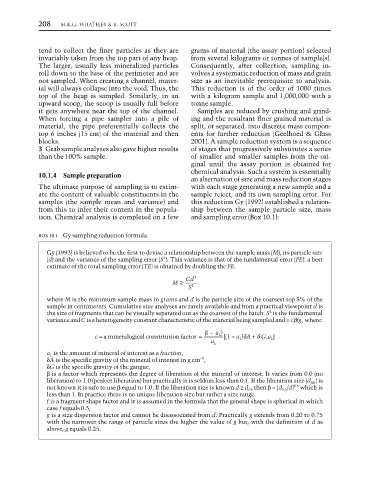
                  samples (the sample mean and variance) and  this reduction Gy (1992) established a relation-
                  from this to infer their content in the popula-  ship between the sample particle size, mass
                  tion. Chemical analysis is completed on a few  and sampling error (Box 10.1):


                  BOX 10.1 Gy sampling reduction formula.

                    Gy (1992) is believed to be the first to devise a relationship between the sample mass (M), its particle size
                                                      2
                    (d) and the variance of the sampling error (S ). This variance is that of the fundamental error (FE): a best
                    estimate of the total sampling error (TE) is obtained by doubling the FE.
                                                         M  ≥  Cd  3
                                                               S 2
                    where M is the minimum sample mass in grams and d is the particle size of the coarsest top 5% of the
                    sample in centimeters. Cumulative size analyses are rarely available and from a practical viewpoint d is
                                                                                     2
                    the size of fragments that can be visually separated out as the coarsest of the batch. S  is the fundamental
                    variance and C is a heterogeneity constant characteristic of the material being sampled and = cβfg, where:
                                                                    −
                                                                  (   )
                                                                  1
                                                                     a L
                                  c = a mineralogical constitution factor  =   [(1 − a L )δA + δ G.a L ]
                                                                       a L
                    a L  is the amount of mineral of interest as a fraction,
                    δA is the specific gravity of the mineral of interest in g cm ,
                                                                 −3
                    δG is the specific gravity of the gangue,
                    β is a factor which represents the degree of liberation of the mineral of interest. It varies from 0.0 (no
                    liberation) to 1.0 (perfect liberation) but practically it is seldom less than 0.1. If the liberation size (d lib ) is
                    not known it is safe to use β equal to 1.0. If the liberation size is known d ≥ d lib  then β= (d lib /d)  which is
                                                                                            0.5
                    less than 1. In practice there is no unique liberation size but rather a size range.
                    f is a fragment shape factor and it is assumed in the formula that the general shape is spherical in which
                    case f equals 0.5,
                    g is a size dispersion factor and cannot be disassociated from d. Practically g extends from 0.20 to 0.75
                    with the narrower the range of particle sizes the higher the value of g but, with the definition of d as
                    above, g equals 0.25.

