


Page 223 - Introduction to Mineral Exploration
P. 223
206   M.K.G. WHATELEY & B. SCOTT


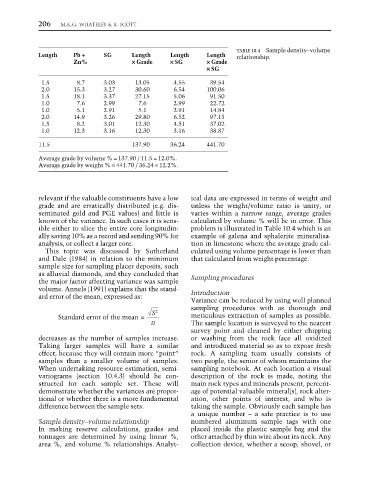
                                                                            TABLE 10.4  Sample density–volume
                  Length    Pb ++ ++ +  SG   Length     Length     Length   relationship.
                            Zn%              × × × × × Grade  × × × × × SG  × × × × × Grade
                                                                   × × × × × SG
                   1.5       8.7     3.03     13.05      4.55       39.54
                   2.0      15.3     3.27     30.60      6.54      100.06
                   1.5      18.1     3.37     27.15      5.06       91.50
                   1.0       7.6     2.99      7.6       2.99       22.72
                   1.0       5.1     2.91      5.1       2.91       14.84
                   2.0      14.9     3.26     29.80      6.52       97.15
                   1.5       8.2     3.01     12.30      4.51       37.02
                   1.0      12.3     3.16     12.30      3.16       38.87
                  11.5                       137.90     36.24      441.70

                  Average grade by volume % = 137.90 / 11.5 = 12.0%.
                  Average grade by weight % = 441.70 / 36.24 = 12.2%.


                  relevant if the valuable constituents have a low  ical data are expressed in terms of weight and
                  grade and are erratically distributed (e.g. dis-  unless the weight/volume ratio is unity, or
                  seminated gold and PGE values) and little is  varies within a narrow range, average grades
                  known of the variance. In such cases it is sens-  calculated by volume % will be in error. This
                  ible either to slice the entire core longitudin-  problem is illustrated in Table 10.4 which is an
                  ally saving 10% as a record and sending 90% for  example of galena and sphalerite mineralisa-
                  analysis, or collect a larger core.         tion in limestone where the average grade cal-
                    This topic was discussed by Sutherland    culated using volume percentage is lower than
                  and Dale (1984) in relation to the minimum  that calculated from weight percentage.
                  sample size for sampling placer deposits, such
                  as alluvial diamonds, and they concluded that  Sampling procedures
                  the major factor affecting variance was sample
                  volume. Annels (1991) explains that the stand-  Introduction
                  ard error of the mean, expressed as:
                                                              Variance can be reduced by using well planned
                                                              sampling procedures with as thorough and
                                                   S  2
                                                =
                        Standard error of the mean            meticulous extraction of samples as possible.
                                                   n          The sample location is surveyed to the nearest
                                                              survey point and cleaned by either chipping
                  decreases as the number of samples increase.  or washing from the rock face all oxidized
                  Taking larger samples will have a similar   and introduced material so as to expose fresh
                  effect, because they will contain more “point”  rock. A sampling team usually consists of
                  samples than a smaller volume of samples.   two people, the senior of whom maintains the
                  When undertaking resource estimation, semi-  sampling notebook. At each location a visual
                  variograms (section 10.4.3) should be con-  description of the rock is made, noting the
                  structed for each sample set. These will    main rock types and minerals present, percent-
                  demonstrate whether the variances are propor-  age of potential valuable mineral(s), rock alter-
                  tional or whether there is a more fundamental  ation, other points of interest, and who is
                  difference between the sample sets.         taking the sample. Obviously each sample has
                                                              a unique number – a safe practice is to use
                  Sample density–volume relationship          numbered aluminum sample tags with one
                  In making reserve calculations, grades and  placed inside the plastic sample bag and the
                  tonnages are determined by using linear %,  other attached by thin wire about its neck. Any
                  area %, and volume % relationships. Analyt-  collection device, whether a scoop, shovel, or

