


Page 218 - Introduction to Mineral Exploration
P. 218
10: EVALUATION TECHNIQUES  201


                   Variance units are the square of the units of  In asymmetrical distributions there is
                 the original observation. A small variance indi-  no comparable relationship between standard
                 cates that observations are clustered tightly  deviation (or variance) and the area under the
                 about the arithmetic mean whilst a large vari-  distribution curve, as in a normal counterpart.
                 ance shows that they are scattered widely about  Consequently, mathematical transformations
                 the mean, and that their central clustering is  have been used whereby skewed data are trans-
                 weak. A useful property of a normal distribu-  formed to normal. Perhaps the commonest
                 tion is that within any specified range, areas  is the log normal transformation where the
                 under its curve can be exactly calculated. For  natural log of all values is used as the distri-
                 example, slightly over two-thirds (68%) of all  bution and many geological data approxim-
                 observations are within one standard deviation  ate to this type of distribution; however, this
                 on either side of the arithmetic mean and    method should be used with caution. Geovari-
                 95% of all values are within ±2 (actually 1.96)  ances (2001) recommend the use of gaussian
                 standard deviations from the mean (Fig. 10.2).  transformation particularly for variable trans-
                 The mean of observations, or average, is their  formation in the geostatistical conditional
                 total sum divided by the number of observa-  simulation process (see section 10.4.3) and for
                 tions, n.                                    use in nonlinear geostatisical techniques such
                                                              as disjunctive kriging and uniform condition-
                 Asymmetrical distributions                   ing (Deutsch 2002). An alternative approach is
                 Much of the data used in geology have an asym-  to use nonparametric statistics.
                 metrical rather than a normal distribution.
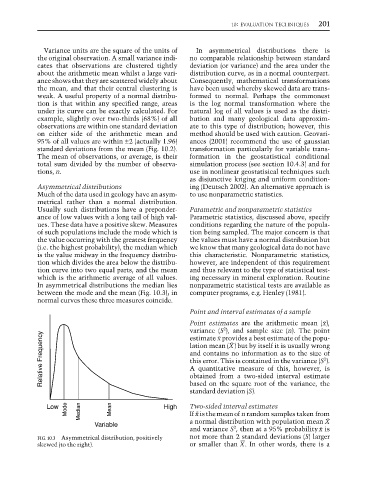
                 Usually such distributions have a preponder-  Parametric and nonparametric statistics
                 ance of low values with a long tail of high val-  Parametric statistics, discussed above, specify
                 ues. These data have a positive skew. Measures  conditions regarding the nature of the popula-
                 of such populations include the mode which is  tion being sampled. The major concern is that
                 the value occurring with the greatest frequency  the values must have a normal distribution but
                 (i.e. the highest probability), the median which  we know that many geological data do not have
                 is the value midway in the frequency distribu-  this characteristic. Nonparametric statistics,
                 tion which divides the area below the distribu-  however, are independent of this requirement
                 tion curve into two equal parts, and the mean  and thus relevant to the type of statistical test-
                 which is the arithmetic average of all values.  ing necessary in mineral exploration. Routine
                 In asymmetrical distributions the median lies  nonparametric statistical tests are available as
                 between the mode and the mean (Fig. 10.3); in  computer programs, e.g. Henley (1981).
                 normal curves these three measures coincide.
                                                              Point and interval estimates of a sample
                                                              Point estimates are the arithmetic mean (X),
                                                                        2
                                                              variance (S ), and sample size (n). The point
                   Relative Frequency                         lation mean (Y) but by itself it is usually wrong
                                                              estimate X provides a best estimate of the popu-
                                                              and contains no information as to the size of
                                                                                                     2
                                                              this error. This is contained in the variance (S ).
                                                              A quantitative measure of this, however, is
                                                              obtained from a two-sided interval estimate
                                                              based on the square root of the variance, the
                                                              standard deviation (S).

                          Mode  Median  Mean                  If X is the mean of n random samples taken from
                    Low                               High    Two-sided interval estimates
                                  Variable                    a normal distribution with population mean Y
                                                                           2
                                                              and variance S , then at a 95% probabilityX is
                 FIG. 10.3 Asymmetrical distribution, positively  not more than 2 standard deviations (S) larger
                 skewed (to the right).                       or smaller than   X. In other words, there is a

