


Page 220 - Introduction to Mineral Exploration
P. 220
10: EVALUATION TECHNIQUES  203


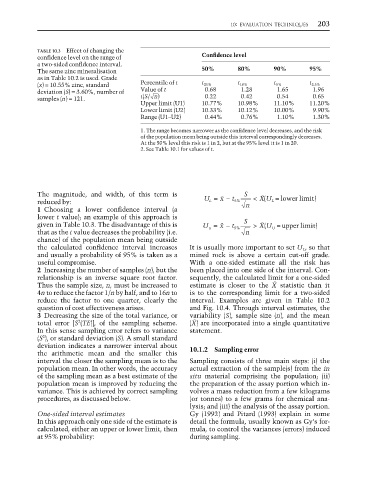
                 TABLE 10.3 Effect of changing the
                 confidence level on the range of                 Confidence level
                 a two-sided confidence interval.
                 The same zinc mineralisation                    50%        80%       90%        95%
                 as in Table 10.2 is used. Grade
                 (x) = 10.55% zinc, standard    Percentile of t  t 25%      t 10%     t 5%       t 2.5%
                 deviation (S) = 3.60%, number of  Value of t     0.68       1.28      1.65       1.96
                 samples (n) = 121.             t(S/    n)        0.22       0.42      0.54       0.65
                                                Upper limit (U1)  10.77%    10.98%    11.10%     11.20%
                                                Lower limit (U2)  10.33%    10.12%    10.00%      9.90%
                                                Range (U1–U2)     0.44%      0.76%     1.10%      1.30%

                                                1. The range becomes narrower as the confidence level decreases, and the risk
                                                of the population mean being outside this interval correspondingly decreases.
                                                At the 50% level this risk is 1 in 2, but at the 95% level it is 1 in 20.
                                                2. See Table 10.1 for values of t.


                 The magnitude, and width, of this term is                    S
                                                                       X
                                                                    L
                 reduced by:                                      U  =   −  t 5 %  n  <    Y(U L  = lower limit)
                 1 Choosing a lower confidence interval (a
                 lower t value); an example of this approach is
                                                                        −
                                                                     =
                                                                                >
                 given in Table 10.3. The disadvantage of this is  U u       t %5  S     Y(U U  = upper limit)
                                                                       X
                 that as the t value decreases the probability (i.e.            n
                 chance) of the population mean being outside
                 the calculated confidence interval increases  It is usually more important to set U L , so that
                 and usually a probability of 95% is taken as a  mined rock is above a certain cut-off grade.
                 useful compromise.                           With a one-sided estimate all the risk has
                 2 Increasing the number of samples (n), but the  been placed into one side of the interval. Con-
                 relationship is an inverse square root factor.  sequently, the calculated limit for a one-sided
                 Thus the sample size, n, must be increased to  estimate is closer to the  Y statistic than it
                 4n to reduce the factor 1/n by half, and to 16n to  is to the corresponding limit for a two-sided
                 reduce the factor to one quarter, clearly the  interval. Examples are given in Table 10.2
                 question of cost effectiveness arises.       and Fig. 10.4. Through interval estimates, the
                 3 Decreasing the size of the total variance, or  variability (S), sample size (n), and the mean
                             2
                 total error [S (TE)], of the sampling scheme.  (Y) are incorporated into a single quantitative
                 In this sense sampling error refers to variance  statement.
                   2
                 (S ), or standard deviation (S). A small standard
                 deviation indicates a narrower interval about
                 the arithmetic mean and the smaller this     10.1.2  Sampling error
                 interval the closer the sampling mean is to the  Sampling consists of three main steps: (i) the
                 population mean. In other words, the accuracy  actual extraction of the sample(s) from the in
                 of the sampling mean as a best estimate of the  situ material comprising the population; (ii)
                 population mean is improved by reducing the  the preparation of the assay portion which in-
                 variance. This is achieved by correct sampling  volves a mass reduction from a few kilograms
                 procedures, as discussed below.              (or tonnes) to a few grams for chemical ana-
                                                              lysis; and (iii) the analysis of the assay portion.
                 One-sided interval estimates                 Gy (1992) and Pitard (1993) explain in some
                 In this approach only one side of the estimate is  detail the formula, usually known as Gy’s for-
                 calculated, either an upper or lower limit, then  mula, to control the variances (errors) induced
                 at 95% probability:                          during sampling.

