


Page 217 - Introduction to Mineral Exploration
P. 217
200   M.K.G. WHATELEY & B. SCOTT


                                                              tion. Mineralisation is composed of dissimilar
                                                              constituents and is heterogeneous – it is rarely
                                                              (if ever) homogenous – and correct sampling of
                                                              such material has to ensure that all constituent
                   Frequency                                  ability of being selected to form the sample,
                                                              units of the population have a uniform prob-
                                                              and the integrity of the sample is respected (see
                                      X 1
                                          X 2                 later). This is the concept of random sampling.

                                                              Normal and asymmetrical distributions
                      Low           Variable            High  This is a brief introduction to the subject of dis-
                                                              tributions. The reader is referred to standard
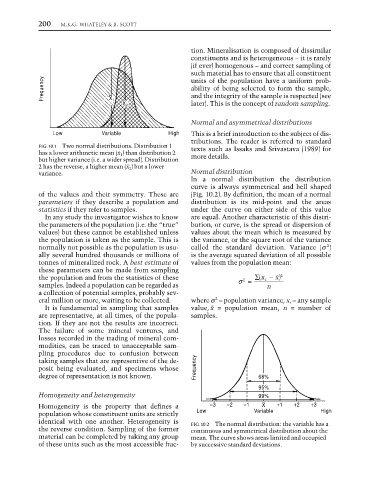
                  FIG. 10.1  Two normal distributions. Distribution 1  texts such as Issaks and Srivastava (1989) for
                  has a lower arithmetic mean (X 1 ) than distribution 2  more details.
                  but higher variance (i.e. a wider spread). Distribution
                  2 has the reverse, a higher mean (X 2 ) but a lower
                  variance.                                   Normal distribution
                                                              In a normal distribution the distribution
                                                              curve is always symmetrical and bell shaped
                  of the values and their symmetry. These are  (Fig. 10.2). By definition, the mean of a normal
                  parameters if they describe a population and  distribution is its mid-point and the areas
                  statistics if they refer to samples.        under the curve on either side of this value
                    In any study the investigator wishes to know  are equal. Another characteristic of this distri-
                  the parameters of the population (i.e. the “true”  bution, or curve, is the spread or dispersion of
                  values) but these cannot be established unless  values about the mean which is measured by
                  the population is taken as the sample. This is  the variance, or the square root of the variance
                                                                                                      2
                  normally not possible as the population is usu-  called the standard deviation. Variance (σ )
                  ally several hundred thousands or millions of  is the average squared deviation of all possible
                  tonnes of mineralized rock. A best estimate of  values from the population mean:
                  these parameters can be made from sampling
                                                                                     −
                  the population and from the statistics of these            2  =  ∑ (   ) X  2
                                                                                   x
                                                                                    i
                  samples. Indeed a population can be regarded as                    σ     n
                  a collection of potential samples, probably sev-
                                                                     2
                  eral million or more, waiting to be collected.  where σ  = population variance, x i  = any sample
                    It is fundamental in sampling that samples  value, X  = population mean,  n  = number of
                  are representative, at all times, of the popula-  samples.
                  tion. If they are not the results are incorrect.
                  The failure of some mineral ventures, and
                  losses recorded in the trading of mineral com-
                  modities, can be traced to unacceptable sam-
                  pling procedures due to confusion between
                  taking samples that are representive of the de-
                  posit being evaluated, and specimens whose    Frequency
                  degree of representation is not known.                          68%

                                                                                  95%
                  Homogeneity and heterogeneity                                   99%
                  Homogeneity is the property that defines a         −3   −2   −1   X   +1   +2   +3
                  population whose constituent units are strictly  Low           Variable           High
                  identical with one another. Heterogeneity is  FIG. 10.2  The normal distribution: the variable has a
                  the reverse condition. Sampling of the former  continuous and symmetrical distribution about the
                  material can be completed by taking any group  mean. The curve shows areas limited and occupied
                  of these units such as the most accessible frac-  by successive standard deviations.

