


Page 231 - Introduction to Mineral Exploration
P. 231
214   M.K.G. WHATELEY & B. SCOTT


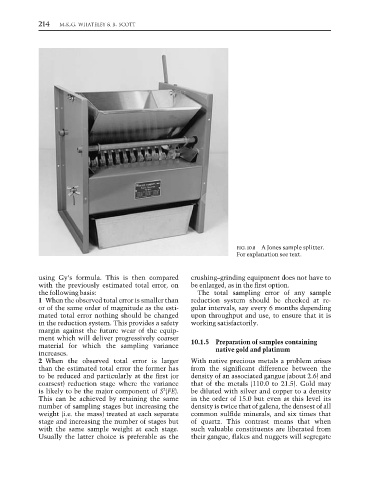
                                                                            FIG. 10.8 A Jones sample splitter.
                                                                            For explanation see text.


                  using Gy’s formula. This is then compared   crushing–grinding equipment does not have to
                  with the previously estimated total error, on  be enlarged, as in the first option.
                  the following basis:                          The total sampling error of any sample
                  1 When the observed total error is smaller than  reduction system should be checked at re-
                  or of the same order of magnitude as the esti-  gular intervals, say every 6 months depending
                  mated total error nothing should be changed  upon throughput and use, to ensure that it is
                  in the reduction system. This provides a safety  working satisfactorily.
                  margin against the future wear of the equip-
                  ment which will deliver progressively coarser
                  material for which the sampling variance    10.1.5  Preparation of samples containing
                  increases.                                         native gold and platinum
                  2 When the observed total error is larger   With native precious metals a problem arises
                  than the estimated total error the former has  from the significant difference between the
                  to be reduced and particularly at the first (or  density of an associated gangue (about 2.6) and
                  coarsest) reduction stage where the variance  that of the metals (110.0 to 21.5). Gold may
                                                      2
                  is likely to be the major component of S (FE).  be diluted with silver and copper to a density
                  This can be achieved by retaining the same  in the order of 15.0 but even at this level its
                  number of sampling stages but increasing the  density is twice that of galena, the densest of all
                  weight (i.e. the mass) treated at each separate  common sulfide minerals, and six times that
                  stage and increasing the number of stages but  of quartz. This contrast means that when
                  with the same sample weight at each stage.  such valuable constituents are liberated from
                  Usually the latter choice is preferable as the  their gangue, flakes and nuggets will segregate

