


Page 236 - Introduction to Mineral Exploration
P. 236
10: EVALUATION TECHNIQUES  219


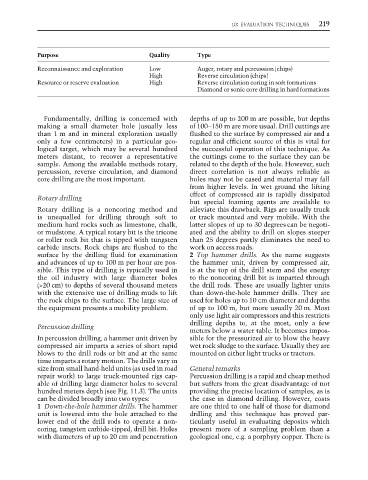
                 Purpose                          Quality       Type

                 Reconnaissance and exploration   Low           Auger, rotary and percussion (chips)
                                                  High          Reverse circulation (chips)
                 Resource or reserve evaluation   High          Reverse circulation coring in soft formations
                                                                Diamond or sonic core drilling in hard formations


                   Fundamentally, drilling is concerned with  depths of up to 200 m are possible, but depths
                 making a small diameter hole (usually less   of 100–150 m are more usual. Drill cuttings are
                 than 1 m and in mineral exploration usually  flushed to the surface by compressed air and a
                 only a few centimeters) in a particular geo-  regular and efficient source of this is vital for
                 logical target, which may be several hundred  the successful operation of this technique. As
                 meters distant, to recover a representative  the cuttings come to the surface they can be
                 sample. Among the available methods rotary,  related to the depth of the hole. However, such
                 percussion, reverse circulation, and diamond  direct correlation is not always reliable as
                 core drilling are the most important.        holes may not be cased and material may fall
                                                              from higher levels. In wet ground the lifting
                                                              effect of compressed air is rapidly dissipated
                 Rotary drilling
                                                              but special foaming agents are available to
                 Rotary drilling is a noncoring method and    alleviate this drawback. Rigs are usually truck
                 is unequalled for drilling through soft to   or track mounted and very mobile. With the

                 medium hard rocks such as limestone, chalk,  latter slopes of up to 30 degrees can be negoti-
                 or mudstone. A typical rotary bit is the tricone  ated and the ability to drill on slopes steeper
                 or roller rock bit that is tipped with tungsten  than 25 degrees partly eliminates the need to
                 carbide insets. Rock chips are flushed to the  work on access roads.
                 surface by the drilling fluid for examination  2 Top hammer drills. As the name suggests
                 and advances of up to 100 m per hour are pos-  the hammer unit, driven by compressed air,
                 sible. This type of drilling is typically used in  is at the top of the drill stem and the energy
                 the oil industry with large diameter holes   to the noncoring drill bit is imparted through
                 (>20 cm) to depths of several thousand meters  the drill rods. These are usually lighter units
                 with the extensive use of drilling muds to lift  than down-the-hole hammer drills. They are
                 the rock chips to the surface. The large size of  used for holes up to 10 cm diameter and depths
                 the equipment presents a mobility problem.   of up to 100 m, but more usually 20 m. Most
                                                              only use light air compressors and this restricts
                                                              drilling depths to, at the most, only a few
                 Percussion drilling
                                                              meters below a water table. It becomes impos-
                 In percussion drilling, a hammer unit driven by  sible for the pressurized air to blow the heavy
                 compressed air imparts a series of short rapid  wet rock sludge to the surface. Usually they are
                 blows to the drill rods or bit and at the same  mounted on either light trucks or tractors.
                 time imparts a rotary motion. The drills vary in
                 size from small hand-held units (as used in road  General remarks
                 repair work) to large truck-mounted rigs cap-  Percussion drilling is a rapid and cheap method
                 able of drilling large diameter holes to several  but suffers from the great disadvantage of not
                 hundred meters depth (see Fig. 11.3). The units  providing the precise location of samples, as is
                 can be divided broadly into two types:       the case in diamond drilling. However, costs
                 1 Down-the-hole hammer drills. The hammer    are one third to one half of those for diamond
                 unit is lowered into the hole attached to the  drilling and this technique has proved par-
                 lower end of the drill rods to operate a non-  ticularly useful in evaluating deposits which
                 coring, tungsten carbide-tipped, drill bit. Holes  present more of a sampling problem than a
                 with diameters of up to 20 cm and penetration  geological one, e.g. a porphyry copper. There is

