


Page 205 - Introduction to Petroleum Engineering
P. 205
192                                                WELL COMPLETIONS
           10.4  ACIDIZING

           The next step after perforating is to clear debris and other damage for a cased and
           cemented hole. If reservoir pressure is sufficiently high, opening the well and starting
           production may be enough to clear the perforations. Acidizing is another option for
           cleaning perforations. At any time in the life of a well, acids can be used to remove
           mineral deposits in the well and the near‐well region in the formation that are lim-
           iting production rate.
              Four acids are often used. Hydrochloric (HCl), formic, and acetic acids attack
           carbonate minerals such as calcite (CaCO ), dolomite (CaMg(CO ) ), and siderite
                                              3
                                                                 3 2
           (FeCO ). Mixtures of hydrochloric and hydrofluoric (HF) acids are used in
                 3
             treatments of silicate minerals such as quartz, various feldspars, and clays. The
           volumetric amount of mineral that can be consumed by these acids depends on
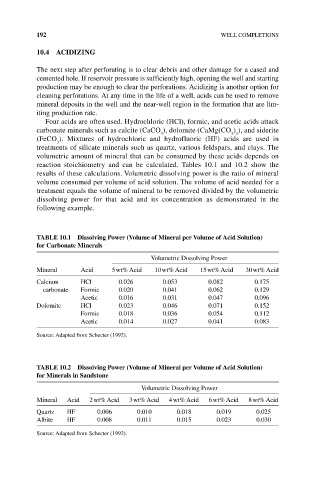
           reaction stoichiometry and can be calculated.  Tables  10.1 and 10.2 show the
           results of these calculations. Volumetric dissolving power is the ratio of mineral
           volume consumed per volume of acid solution. The volume of acid needed for a
           treatment equals the volume of mineral to be removed divided by the volumetric
           dissolving power for that acid and its concentration as demonstrated in the
             following example.


           TAbLE 10.1  Dissolving Power (Volume of Mineral per Volume of Acid Solution)
           for Carbonate Minerals
                                           Volumetric Dissolving Power
           Mineral     Acid     5 wt% Acid  10 wt% Acid  15 wt% Acid  30 wt% Acid
           Calcium     HCl        0.026       0.053        0.082        0.175
             carbonate  Formic    0.020       0.041        0.062        0.129
                       Acetic     0.016       0.031        0.047        0.096
           Dolomite    HCl        0.023       0.046        0.071        0.152
                       Formic     0.018       0.036        0.054        0.112
                       Acetic     0.014       0.027        0.041        0.083

           Source: Adapted from Schecter (1992).


           TAbLE 10.2  Dissolving Power (Volume of Mineral per Volume of Acid Solution)
           for Minerals in Sandstone

                                        Volumetric Dissolving Power
           Mineral  Acid  2 wt% Acid  3 wt% Acid  4 wt% Acid  6 wt% Acid  8 wt% Acid
           Quartz   HF      0.006      0.010      0.018      0.019      0.025
           Albite   HF      0.008      0.011      0.015      0.023      0.030

           Source: Adapted from Schecter (1992).

