


Page 201 - Materials Chemistry, Second Edition
P. 201
EXERGY ANALYSIS AND ITS CONNECTION TO LIFE CYCLE ASSESSMENT         187

              study is included in which LCA and ExLCA methods are applied to a complex
              process: nuclear-based hydrogen production.


              8.2 Life Cycle Assessment


              LCA is a useful method for investigating the environmental impacts of a product
              or process. It is a cradle-to-grave analysis in which not only the usage stage but
              also other stages in the life of a product or process are taken into consideration,
              such as production, transportation and disposal. LCA is used to determine and
              assess overall environmental impacts and to define the most environmentally
              critical phase in order to decrease the negative environmental effects of a prod-
              uct or a process. LCA is also conducted to compare competing products or pro-
              cesses and thereby identify which is more environmentally benign.
                The International Standards of Organization (ISO) developed its 14000 series
              for life cycle assessment, including several parts:


                   • ISO-14040, Life Cycle Assessment - Principles and Framework
                      (ISO, 1997)
                   • ISO-14041, Life Cycle Assessment - Goal and Scope Definition
                      and Inventory Analysis (ISO, 1998)
                   • ISO-14042, Life Cycle Assessment - Life Cycle Impact Assessment
                      (ISO, 2000)
                   • ISO-14043, Life Cycle Assessment - Life Cycle Interpretation
                      (ISO, 2000)
                   • ISO-14044, Life Cycle Assessment - Requirements and Guidelines
                      (ISO, 2006)


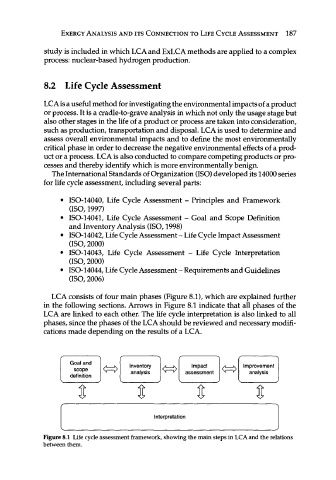
                LCA consists of four main phases (Figure 8.1), which are explained further
              in the following sections. Arrows in Figure 8.1 indicate that all phases of the
              LCA are linked to each other. The life cycle interpretation is also linked to all
              phases, since the phases of the LCA should be reviewed and necessary modifi-
              cations made depending on the results of a LCA.


                      Goal and          Inventory         Impact          Improvement
                       scope    ΦΦ      analysis   ΦΦ    assessment   «= >
                      definition                                            analysis
                        t                 t                 t                 t


                                               Interpretation

              Figure 8.1 Life cycle assessment framework, showing the main steps in LCA and the relations
              between them.

