


Page 205 - Materials Chemistry, Second Edition
P. 205
EXERGY ANALYSIS AND ITS CONNECTION TO LIFE CYCLE ASSESSMENT         191

                      loses its quality, exergy is usually destroyed. Energy forms with
                      high exergy contents are typically more valued and useful than
                      energy forms with low exergy. Exergy is often a valuable resource,
                      and it is observed to be a measure of value for both energy and
                      non-energy resources.
                   • Exergy efficiencies are a measure of approach to ideality. This
                      is not necessarily true for energy efficiencies, which are often
                      misleading.


              8.3.2 Exergy Analysis

              Exergy analysis is an assessment too based on exergy in which exergy flows,
              balances, destructions and efficiencies are determined for an overall process or
              system and its subparts. Exergy analysis permits many of the shortcomings of
              energy analysis to be overcome. Exergy analysis is based on the second law of
              thermodynamics, and is useful in identifying the causes, locations and mag-
              nitudes of process inefficiencies. Exergy analysis acknowledges that, although
              energy cannot be created or destroyed, it can be degraded in quality, eventually
              reaching a state in which it is in complete equilibrium with the surroundings
              and hence of no further use for performing tasks (Dincer and Rosen, 2007).
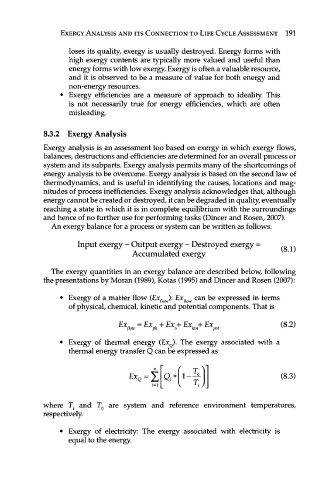
                An exergy balance for a process or system can be written as follows:

                        Input exergy - Output exergy - Destroyed exergy =             (~*.
                                         Accumulated exergy

                The exergy quantities in an exergy balance are described below, following
              the presentations by Moran (1989), Kotas (1995) and Dincer and Rosen (2007):

                   • Exergy of a matter flow (Ex flow): Ex flow can be expressed in terms
                      of physical, chemical, kinetic and potential components. That is

                                     Ex, =Ex  U + Ex + Ex,. + Ex .                    (8.2)
                                       flow    ph    o     kin   pot
                   • Exergy of thermal energy (Ex Q). The exergy associated with a
                      thermal energy transfer Q can be expressed as

                                                      f    γ \
                                        ΕΧ                                           (8.3)
                                          Ω=Σ  Qi       1 °-
                                               i'=l

              where T. and T 0 are system and reference environment temperatures,
              respectively.

                   • Exergy of electricity: The exergy associated with electricity is
                      equal to the energy.

