


Page 206 - Materials Chemistry, Second Edition
P. 206
192   LIFE  CYCLE ASSESSMENT HANDBOOK

              8.4    Exergetic Life Cycle Assessment          (ExLCA)

              In this  section,  exergetic  life  cycle assessment  is described,  including  discus-
              sions  of the following  topics:

                   •  Linkages between exergy analysis and  LCA
                   •  Rationale for  ExLCA
                   •  ExLCA approach and    methodology
                   •  Applications  of ExLCA
                   •  Advantages and benefits  of ExLCA over LCA


              8.4.1  Linkages between     Exergy Analysis and    LCA
              Environmental   impacts  associated  with  systems  or  processes  can  often
              be  decreased  by  reducing  exergy  losses  or,  correspondingly,  increasing
              exergy efficiencies.  Exergy analysis is primarily a powerful  tool for  improv-
              ing  the  efficiency  of  processes  and  systems,  particularly  -  but  not  neces-
              sarily  -  energy-intensive  ones. A measure  that  increases  efficiency  allows,
              for  the same products  or services delivered, less resources  (or exergy) to be
              used.  This, in turn,  reduces  the  extraction  from  the  environment  of  energy
              resources, such  as fossil  fuels  and  uranium  (Rosen, 2002). Increased  exergy
              efficiency  also  reduces  the  requirements  associated  with  new  facilities  for
              the  production,  transportation,  transformation,  and  distribution  of  the
              various  energy  forms,  all  of  which  impact  the  environment  (Dincer,  2000;
              Rosen, 2002).
                 Exergy losses occur during the lifetime  of a product or a process. Reducing
              these losses, particularly those due to the use  of non-renewable energy  forms,
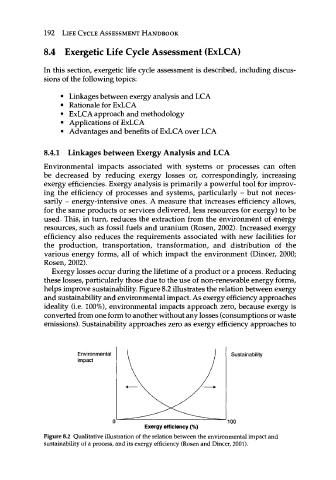
              helps improve sustainability. Figure 8.2 illustrates the relation between exergy
              and sustainability and environmental impact. As exergy efficiency  approaches
              ideality  (i.e.  100%), environmental  impacts  approach  zero, because  exergy  is
              converted from one form to another without any losses (consumptions or waste
              emissions). Sustainability  approaches  zero as exergy  efficiency  approaches  to


                        Environmental                                 Sustainability
                        impact


                                   0
                                            Exergy efficiency  (%)
              Figure  8.2  Qualitative  illustration  of the relation between  the environmental  impact  and
              sustainability  of a process, and its exergy  efficiency  (Rosen and  Dincer, 2001).

