


Page 112 - Low Temperature Energy Systems with Applications of Renewable Energy
P. 112
Effective use of heat pumps for various heating applications      101

           3.3.1.1  Ventilation with an exhaust air heat recovery unit

           In order to have air at the required temperature supplied to a room, radiators (heaters)
           of different models are used to heat the inflow air in the simplest ventilation systems.
           They can be water (steam), gas, or electric depending on the source of heat. The de-
           cision concerning the use of a particular type of heater for a particular system is
           made based on specific conditions, possibilities, and economic expediency. Hot water
           or electric heating is preferred because they offer the opportunity to control the tem-
           perature of air more precisely. When exhaust air at the temperature in a room is simply
           discharged to the environment, the efficiency of such systems is very low. So, exhaust
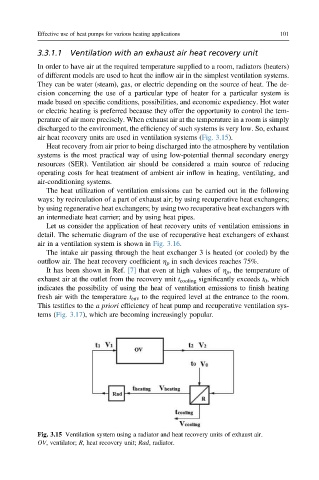
           air heat recovery units are used in ventilation systems (Fig. 3.15).
              Heat recovery from air prior to being discharged into the atmosphere by ventilation
           systems is the most practical way of using low-potential thermal secondary energy
           resources (SER). Ventilation air should be considered a main source of reducing
           operating costs for heat treatment of ambient air inflow in heating, ventilating, and
           air-conditioning systems.
              The heat utilization of ventilation emissions can be carried out in the following
           ways: by recirculation of a part of exhaust air; by using recuperative heat exchangers;
           by using regenerative heat exchangers; by using two recuperative heat exchangers with
           an intermediate heat carrier; and by using heat pipes.
              Let us consider the application of heat recovery units of ventilation emissions in
           detail. The schematic diagram of the use of recuperative heat exchangers of exhaust
           air in a ventilation system is shown in Fig. 3.16.
              The intake air passing through the heat exchanger 3 is heated (or cooled) by the
           outflow air. The heat recovery coefficient h p in such devices reaches 75%.
              It has been shown in Ref. [7] that even at high values of h p , the temperature of
           exhaust air at the outlet from the recovery unit t cooling significantly exceeds t 0 , which
           indicates the possibility of using the heat of ventilation emissions to finish heating
           fresh air with the temperature t env to the required level at the entrance to the room.
           This testifies to the a priori efficiency of heat pump and recuperative ventilation sys-
           tems (Fig. 3.17), which are becoming increasingly popular.


           Fig. 3.15 Ventilation system using a radiator and heat recovery units of exhaust air.
           OV, ventilator; R, heat recovery unit; Rad, radiator.

