


Page 119 - Low Temperature Energy Systems with Applications of Renewable Energy
P. 119
108                 Low-Temperature Energy Systems with Applications of Renewable Energy

         of the premises becomes active. The results of the operation of the heat pump system
         showed that the total operating costs during the heating period were reduced to 20% of
         heating from a boiler house.


         3.3.4  Examples of effective use of heat pumps
         3.3.4.1  Airports
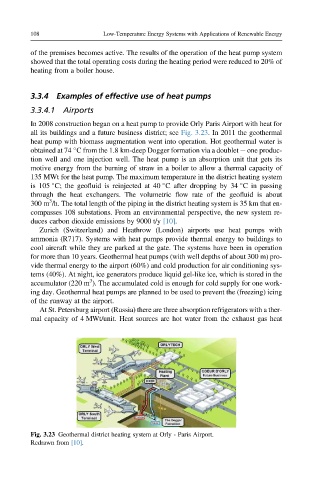
         In 2008 construction began on a heat pump to provide Orly Paris Airport with heat for
         all its buildings and a future business district; see Fig. 3.23. In 2011 the geothermal
         heat pump with biomass augmentation went into operation. Hot geothermal water is

         obtained at 74 C from the 1.8 km-deep Dogger formation via a doublet e one produc-
         tion well and one injection well. The heat pump is an absorption unit that gets its
         motive energy from the burning of straw in a boiler to allow a thermal capacity of
         135 MWt for the heat pump. The maximum temperature in the district heating system


         is 105 C; the geofluid is reinjected at 40 C after dropping by 34 C in passing
         through the heat exchangers. The volumetric flow rate of the geofluid is about
              3
         300 m /h. The total length of the piping in the district heating system is 35 km that en-
         compasses 108 substations. From an environmental perspective, the new system re-
         duces carbon dioxide emissions by 9000 t/y [10].
            Zurich (Switzerland) and Heathrow (London) airports use heat pumps with
         ammonia (R717). Systems with heat pumps provide thermal energy to buildings to
         cool aircraft while they are parked at the gate. The systems have been in operation
         for more than 10 years. Geothermal heat pumps (with well depths of about 300 m) pro-
         vide thermal energy to the airport (60%) and cold production for air conditioning sys-
         tems (40%). At night, ice generators produce liquid gel-like ice, which is stored in the
                         3
         accumulator (220 m ). The accumulated cold is enough for cold supply for one work-
         ing day. Geothermal heat pumps are planned to be used to prevent the (freezing) icing
         of the runway at the airport.
            At St. Petersburg airport (Russia) there are three absorption refrigerators with a ther-
         mal capacity of 4 MWt/unit. Heat sources are hot water from the exhaust gas heat


         Fig. 3.23 Geothermal district heating system at Orly - Paris Airport.
         Redrawn from [10].

