


Page 118 - Low Temperature Energy Systems with Applications of Renewable Energy
P. 118
Effective use of heat pumps for various heating applications      107


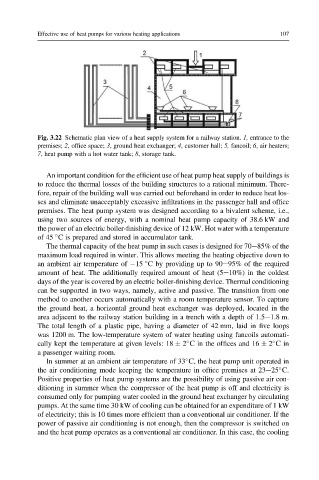
           Fig. 3.22 Schematic plan view of a heat supply system for a railway station. 1, entrance to the
           premises; 2,office space; 3, ground heat exchanger; 4, customer hall; 5, fancoil; 6, air heaters;
           7, heat pump with a hot water tank; 8, storage tank.

              An important condition for the efficient use of heat pump heat supply of buildings is
           to reduce the thermal losses of the building structures to a rational minimum. There-
           fore, repair of the building wall was carried out beforehand in order to reduce heat los-
           ses and eliminate unacceptably excessive infiltrations in the passenger hall and office
           premises. The heat pump system was designed according to a bivalent scheme, i.e.,
           using two sources of energy, with a nominal heat pump capacity of 38.6 kW and
           the power of an electric boiler-finishing device of 12 kW. Hot water with a temperature

           of 45 C is prepared and stored in accumulator tank.
              The thermal capacity of the heat pump in such cases is designed for 70e85% of the
           maximum load required in winter. This allows meeting the heating objective down to

           an ambient air temperature of  15 C by providing up to 90e95% of the required
           amount of heat. The additionally required amount of heat (5e10%) in the coldest
           days of the year is covered by an electric boiler-finishing device. Thermal conditioning
           can be supported in two ways, namely, active and passive. The transition from one
           method to another occurs automatically with a room temperature sensor. To capture
           the ground heat, a horizontal ground heat exchanger was deployed, located in the
           area adjacent to the railway station building in a trench with a depth of 1.5e1.8 m.
           The total length of a plastic pipe, having a diameter of 42 mm, laid in five loops
           was 1200 m. The low-temperature system of water heating using fancoils automati-
           cally kept the temperature at given levels: 18   2 S in the offices and 16   2 S in


           a passenger waiting room.
              In summer at an ambient air temperature of 33 S, the heat pump unit operated in


           the air conditioning mode keeping the temperature in office premises at 23e25 S.
           Positive properties of heat pump systems are the possibility of using passive air con-
           ditioning in summer when the compressor of the heat pump is off and electricity is
           consumed only for pumping water cooled in the ground heat exchanger by circulating
           pumps. At the same time 30 kW of cooling can be obtained for an expenditure of 1 kW
           of electricity; this is 10 times more efficient than a conventional air conditioner. If the
           power of passive air conditioning is not enough, then the compressor is switched on
           and the heat pump operates as a conventional air conditioner. In this case, the cooling

